Multi-Channel Inventory Management Software: 13 Tools

Key takeaway: Multi-channel inventory management software solves one of three problems: forecasting what to buy, keeping counts in sync, or running the whole operation. For Shopify plus Amazon sellers doing $500K to $10M, ReplenishRadar is the forecasting pick because it plans both channels from one number and builds the FBA shipment. Sumtracker for cheap sync across five marketplaces, Zoho Inventory for four. Linnworks for channel sprawl. Cin7 or Brightpearl for wholesale.
Multi-channel inventory management software, in two sentences
Multi-channel inventory management software keeps one stock count across every place you sell. It either syncs that count so you do not oversell, forecasts combined demand so you order the right amount, or both. You need it the moment a sale on one channel is not instantly visible on the others. For most sellers that is the moment they add a second channel at all.
I managed a 200-product catalog across Shopify and Amazon for two years from spreadsheets. Every week at least one product oversold, because I updated the Amazon count twenty minutes after a Shopify sale took the last three units. That was the easy problem. Sync software fixes it, and eight of the thirteen tools below do.
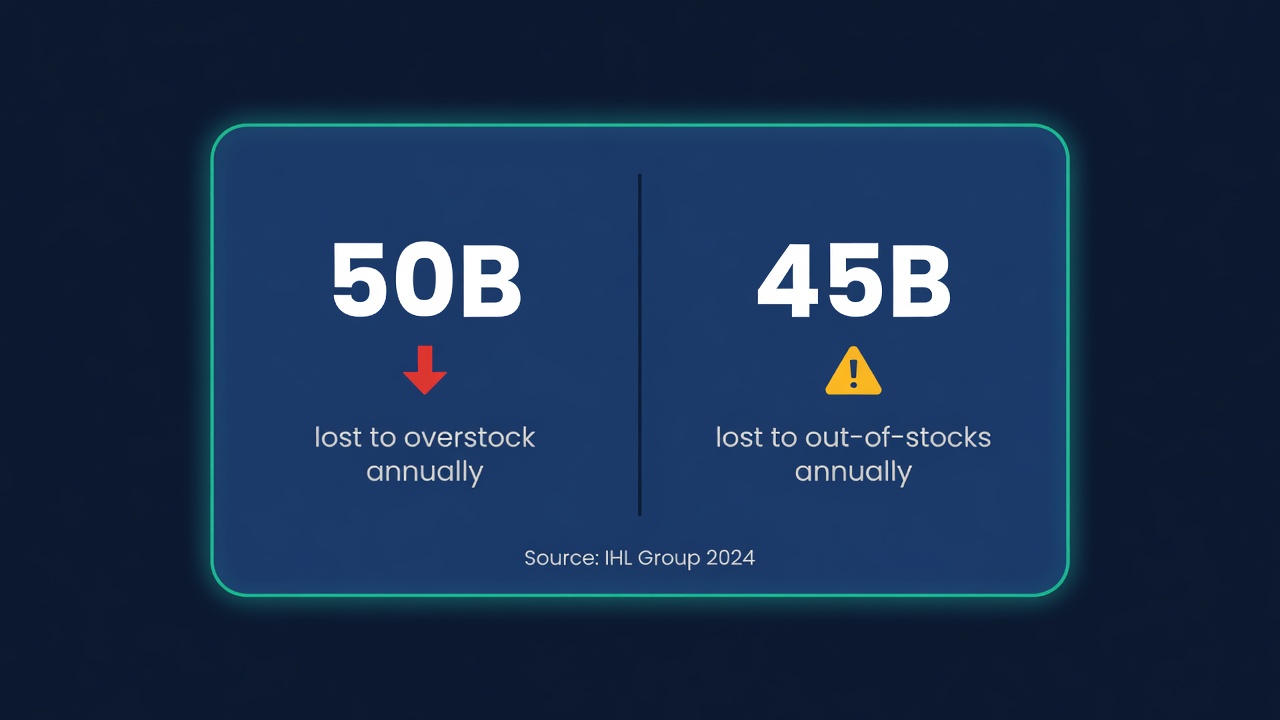
The hard problem was forecasting. A product selling 8 a day on Amazon and 4 a day on Shopify needs 12 a day of supply. I was ordering for each channel separately and never worked out why I kept running short. IHL Group puts U.S. and Canadian retail losses at $350 billion a year to overstock and $145 billion to out-of-stocks. Multi-channel sellers get hit from both sides because the numbers live in different systems. eMarketer estimates Amazon alone took around 38 percent of U.S. online spending; forecast it apart from the rest of your business and you are guessing on the biggest channel you have.
Thirteen tools below, grouped by which of the two problems they solve. I have used or evaluated all of them. Prices are what each vendor published when I checked in September 2026, and they move; the "Pricing" line under each one says how current the number is. If forecasting is the only job you are hiring for, the inventory forecasting software comparison goes deeper on that half.
Sort them yourself before you read a single writeup. Answer four questions, channel mix, order volume, whether you need forecasting or just sync, and budget, and the list below narrows to what actually fits.
Find your fit among the 12 tools
Answer four questions about your setup. The list below updates as you go.
Tick where you sell to see whether ReplenishRadar fits.
ReplenishRadar plans Shopify and Amazon together. It does not cover other marketplaces.
3 of 12 tools fit
Hidden: 1 above your budget band, 5 built for a different order volume. A tool can be both; widen the budget or order-volume answer to see them.
Prediko
From $49/mochecked 2026-10-20- Covers every channel you picked (Shopify and Amazon FBA (native since October 2026); cannot create FBA shipments).
- Forecasts demand - reads Amazon FBA inventory and sales but does not build FBA shipments; methodology is not published (opaque).
Sumtracker
From $59/mochecked 2026-09-07- Covers every channel you picked (Shopify, Amazon, eBay, Etsy, Walmart (up to 10 channels)).
- Forecasts demand - only on the $119/mo Replenish plan; the $59 Manage plan is sync only.
ReplenishRadar
From $99/mo- Covers every channel you picked (Shopify, Amazon).
- Forecasts demand, not just stock counts.
* Order-volume fit and channel support are read from each vendor's published plans and our own comparison pages, not a live quote. Prices move; check the vendor's pricing page before you commit.
What it costs
The number that matters is the entry tier, because that is what tells you whether the tool even opens a door at your size. What it limits at that entry price matters just as much: a $29 plan that caps you at 500 orders a month is not comparable to one with no order cap.
| Tool | Entry price | What the entry tier limits |
|---|---|---|
| ReplenishRadar | Published, month to month, no sales call. Once you tick a channel, the finder above names the plan and price for your volume; pricing has every tier | Each plan caps stores, SKUs and order lines per month; the caps are on the pricing page |
| Veeqo | $19/mo | Inventory only, priced by order volume; shipping itself is free |
| Zoho Inventory | $29/mo | 500 orders/month, then $79, $129, $249 as volume rises |
| Sellbrite | $29/mo | No forecasting at all, quantity sync only |
| Prediko | $49/mo | Under $100k GMV, then a quote; Shopify and Amazon FBA, no FBA shipments |
| Sumtracker | $59/mo | Manage plan is sync only; forecasting needs the $119 Replenish plan |
| SKU Compass | $79/mo | First 20,000 orders, then $125 per extra 20,000; unlimited SKUs |
| Linnworks | ~$199/mo, third-party estimate | Linnworks stopped publishing plans; quoted by order volume |
| Inventory Planner | ~$245/mo, quote | 12-month contract with auto-renewal, climbs fast with product count |
| Cin7 | $349/mo | Setup runs four to eight weeks with an onboarding specialist |
| Ordoro | $349/mo | Inventory module only, separate from the shipping product |
| Brightpearl | ~$500/mo, quote | Quote-only, typically $500 and up |
| Extensiv | Pricing on request | Custom enterprise quote; no published figure to check against |
Can one tool handle Shopify and Amazon both?
Yes, but "handle" means two different things and most buyers conflate them. A sync tool keeps both channels' stock counts true in near real time, which stops the oversell. A planning tool, the kind sold as inventory replenishment software, goes further: it forecasts combined demand across both channels, then sizes the reorder and the Amazon transfer for the total rather than for each channel separately.
Sumtracker, Zoho Inventory, Veeqo and Sellbrite handle the sync version for both channels. ReplenishRadar handles the planning version, specifically for Shopify and Amazon, which is the pair it was built for. Inventory Planner sits in between: it reads Amazon sales into its forecast but does not create FBA shipments, track receiving per fulfillment center, or size transfers against Amazon's capacity limits, so once Amazon crosses 40 percent of revenue you are running FBA replenishment by hand next to the tool.
The forecasting tools
These decide what you buy. If your stockouts come from ordering too little or too late, start here.
ReplenishRadar: best for Shopify plus Amazon
- Best for: Shopify plus Amazon sellers who need one forecast, not two counts.
- Channels: Shopify, Amazon.
- Forecasting: Yes, per-SKU pattern detection, combined across both channels.
- Price: published, month to month, no sales call. Tick a channel in the finder above and it names the plan and price for your volume; pricing has every tier.
We built ReplenishRadar for the case most tools handle badly: a seller on both Shopify and Amazon who needs one forecast, not two counts. It pulls sales history from both channels and forecasts demand across them, so a reorder suggestion is sized for the total 12 a day, not 8 and 4 separately. Most tools either sync counts without forecasting (Sellbrite, Zoho, Ordoro) or forecast one channel and bolt the other on afterwards. Shopify-led catalogs get the same math through our Shopify forecasting workflow.
The FBA piece is where the gap opens. ReplenishRadar builds transfer recommendations from your FBA stock, warehouse stock and Amazon's capacity limits, and it tracks how long each fulfillment center takes to receive what you send. If you have 500 units in the warehouse and Amazon wants 200 while Shopify needs 150 over the next two weeks, it shows you that sending 300 to FBA leaves your own store short, then creates the inbound plan through Amazon's API rather than handing you a number to type into Seller Central.
Not the right fit if you sell on six or more marketplaces and need listing management for eBay, Etsy and Walmart. The feature comparison lists what each tier includes. 14-day free trial with everything on.
SKU Compass: forecasting plus Walmart and WooCommerce
- Best for: Sellers on Amazon, Walmart and Shopify with a long catalog.
- Channels: Amazon, Walmart, Shopify, WooCommerce, per its pricing page.
- Forecasting: Yes, per-SKU reorder points with a forecast that refreshes nightly.
- Price: $79/mo including the first 20,000 orders, then $125 per extra 20,000. Checked on skucompass.com/pricing on September 28, 2026.
SKU Compass forecasts across more marketplaces than we do, and it prices by order volume with no SKU cap. Its self-serve plan generates purchase orders from the forecast, and its home page covers moving stock between FBA, AWD and your warehouses. It also sells managed plans that add a dedicated inventory analyst for $1,997 a month on top of usage. If Walmart is a real channel for you, put it on the shortlist. The forecasting software comparison covers it next to six other planning tools.
Inventory Planner: best for Shopify-heavy catalogs with a team
- Best for: Shopify-heavy catalogs with a team to run open-to-buy.
- Channels: Shopify plus a few, including Amazon demand read-only.
- Forecasting: Yes, deep and tunable per product and per location.
- Price: About $245/mo, quoted by revenue, 12-month contract.
Inventory Planner, now owned by Sage, has been the default Shopify forecasting app for years. Deep forecasting, purchase orders, open-to-buy reports, and settings you can tune per product and per location. If 80 percent of your business runs through Shopify and Amazon is a side channel, it covers you. Amazon is where it thins out: it reads Amazon demand into the forecast but does not create FBA shipments, track receiving per fulfillment center, or size transfers against capacity limits.
Prediko: reads Amazon, cannot build the FBA shipment
- Best for: Shopify-led DTC brands that have outgrown spreadsheets.
- Channels: Shopify and Amazon FBA (native since October 2026); cannot create FBA shipments. Checked October 21, 2026.
- Forecasting: Yes, but the methodology is not published.
- Price: $49/mo under $100k in sales, then a quote.
Prediko targets Shopify DTC brands with a clean forecasting screen, purchase planning and cash flow projections. As of October 2026 its Amazon integration feeds FBA inventory and Amazon sales into the forecast. It belongs on this page mostly as a caution for FBA sellers: it cannot create the FBA shipment, so deciding what to send to Amazon and building the inbound plan stays a manual job in Seller Central, on top of a forecast whose method you cannot inspect.
The sync tools
These keep one count true everywhere. If your problem is oversells and counts that disagree, start here, and know that most of them will not tell you what to order.
Sumtracker: best cheap sync across marketplaces
- Best for: Sellers on 3 to 10 marketplaces whose first pain is counts.
- Channels: Shopify, Amazon, eBay, Etsy, Walmart, up to 10 channels and 10 warehouses.
- Forecasting: Only on the $119 Replenish plan; the $59 Manage plan is sync only.
- Price: $59/mo (Manage), $119/mo (Replenish, adds forecasting and POs).
The $59 Manage plan covers the sync, bundles, stocktakes and barcodes for 2,500 orders a year. The $119 Replenish plan adds purchase orders, transfers and a 12-month forecast with reorder suggestions. The Amazon connection is a stock sync, not FBA planning. Full comparison: ReplenishRadar vs Sumtracker.
Zoho Inventory: cheapest entry, basic planning
- Best for: Small sellers already running Zoho Books or CRM.
- Channels: Shopify, Amazon, eBay, Etsy.
- Forecasting: No, reorder points are typed and maintained by hand.
- Price: $29/mo for 500 orders, then $79, $129, $249 as volume rises.
Worth it if you already run Zoho Books or CRM, because it shares their login and data. The planning is a number you type and maintain, not one it calculates. Full comparison: ReplenishRadar vs Zoho Inventory.
Veeqo: Amazon's own, shipping first
- Best for: High-volume shippers who want Amazon-deep integration.
- Channels: Amazon, Shopify, eBay, Walmart.
- Forecasting: Yes, but it supports shipping decisions more than buying ones.
- Price: $19/mo for inventory, by order volume; shipping is free.
Amazon owns Veeqo, so the shipping is free and the Amazon integration is as deep as it gets. It is built around the packing bench, and purchase ordering is thin. Full comparison: ReplenishRadar vs Veeqo.
Sellbrite: best for listing to many channels
- Best for: Getting the same product listed consistently across many channels.
- Channels: 10 or more, including Shopify, Amazon, eBay, Etsy, Walmart.
- Forecasting: No. It tells you what you have, never what you will need.
- Price: $29/mo, quantity sync only.
If your problem is listing consistency rather than buying decisions, Sellbrite does it cheaply, with quantity sync to stop oversells and nothing past that.
The operations suites
These run the business, and inventory is one module. You buy them for the portal, the EDI, the warehouse, or the accounting, and accept that the planning inside is usually basic.
Linnworks: best for channel sprawl
- Best for: Channel sprawl across 100-plus integrations.
- Channels: Shopify, Amazon, eBay, Etsy, Walmart, your own site, and 100-plus integrations.
- Forecasting: Limited; centralizing orders and printing labels is the point, not planning.
- Price: Quoted by order volume; third-party listings put entry around $199 to $449/mo.
Linnworks centralizes orders, syncs stock everywhere, and prints the labels. It bought SkuVault in 2022, so the warehouse management now lives inside it as SkuVault Core. Implementation takes weeks on a complex channel setup.
Cin7: best for wholesale plus DTC
- Best for: Selling direct and through retailers, with a B2B portal and EDI.
- Channels: Shopify, Amazon, plus multi-location warehouses and EDI for big-box accounts.
- Forecasting: Basic; the depth is in the warehouse and EDI, not the buying decision.
- Price: $349/mo to start.
Cin7 earns its place when you sell direct and through retailers. Setup runs four to eight weeks with an onboarding specialist. At $349 a month to start it is far more tool than a two-person brand on Shopify and Amazon needs, and far less planning depth than the forecasting tools above.
Brightpearl: best for retail plus wholesale
- Best for: Mid-market retailers with physical stores and wholesale accounts.
- Channels: Shopify, Amazon, physical stores and wholesale accounts.
- Forecasting: Yes, alongside a built-in general ledger and order management.
- Price: Quote, typically $500/mo and up.
Brightpearl targets mid-market retailers. Sage bought it in 2021. The e-commerce inventory features are adequate rather than specialized; for Shopify plus Amazon forecasting it is a generalist competing with specialists.
Extensiv: enterprise and 3PLs
- Best for: Enterprise sellers and 3PLs at thousands of orders a day.
- Channels: Shopify, Amazon, multi-warehouse and 3PL routing.
- Forecasting: Yes, with routing rules and deep automation across warehouses.
- Price: Pricing on request. Extensiv is not in our competitor price registry, so we have no verified figure to publish.
Extensiv, formerly Skubana, is where you graduate at thousands of orders a day across warehouses and 3PLs. An NRF Foundation study found retailers running three or more fulfillment nodes carry 18 to 23 percent higher logistics costs, and Extensiv exists to manage that. Expect a real implementation alongside the quote.
Ordoro: shipping with inventory attached
- Best for: Shipping and labels first, inventory attached.
- Channels: Shopify, Amazon, several others.
- Forecasting: No. Stock sync and order management only.
- Price: $349/mo, a separate module from the shipping product.
Ordoro is shipping software first. Good if labels are your pain. Look elsewhere if buying is.
If you are leaving one of these
Search Console tells me a lot of you land here looking for a way out of a specific tool. Here is the short version for each.
Inventory Planner. Check the renewal date before you start, because the contract is 12 months with auto-renewal. Export your supplier lead times and any per-product settings you tuned. Sales history is in Shopify and Amazon, so forecasts rebuild on their own. ReplenishRadar if Amazon matters to you or you want a published price; Sumtracker's $119 plan if sync across marketplaces matters more than forecast depth. The full comparison.
SkuVault. It is SkuVault Core by Linnworks now, quoted rather than priced, and its strength is the warehouse, not the buying decision. If you kept it for bin-level picking, stay and add a planning layer. If you kept it for the counts, Sumtracker does that for a published $59.
DigitBridge. An omnichannel ERP from $299 a month for one or two users, with an onboarding fee, and 250-plus channel connectors. It is the right size for a brand with a real operations team and the wrong size for a Shopify plus Amazon seller who needs to know what to order.
Threecolts Multichannel Pro. A custom-priced enterprise plan for sellers over $1M, bundled with the Seller 365 suite. If what you used was the Amazon-side tools, InventoryLab and the repricer, ReplenishRadar replaces the restock planning and adds Shopify. The rest of the bundle has no equivalent here and you may want to keep it.
Stocky. It shut down on August 31, 2026. The dedicated alternatives guide covers the whole replacement field.
The five problems you are actually solving
1. Demand coordination, $20K to $100K a year at risk
Sell 10 a day on Shopify and 20 a day on Amazon and your purchasing has to cover 30. I have watched sellers forecast each channel on its own, order for 25 a day in total, and stock out three weeks early. IHL Group estimates out-of-stocks cost retailers 4.1 percent of annual revenue. On a $2M multi-channel seller that is $82,000. Run your combined rate through a reorder point calculator and the gap shows up in a minute.
2. Visibility
Each channel shows its own count. You need one view of the warehouse, FBA, any 3PL, and what is in transit. A Shopify study found 73 percent of shoppers expect to buy on one channel and return through another, which only works when the system knows where everything is.
3. Oversells
Without near-real-time sync, selling the last five units on Shopify while someone checks out on Amazon is an oversell. The fixes are sync, a safety buffer per channel, or one pool that decrements everywhere at once. Most tools here sync. The interval matters: a 30-minute sync is not a 5-minute sync when you move 50 units an hour.
4. Allocation
With limited stock, which channel gets it? More at FBA means Prime and the Buy Box. Shopify sales carry a better margin because you skip the referral and FBA fees. There is no universal answer, and a tool should show you the tradeoff in units and dollars rather than leave you to guess.
5. FBA's own rules
Amazon adds layers a DTC-only tool does not know about: capacity limits, inbound placement fees, long-term storage fees, and receiving times that vary by fulfillment center. Jungle Scout's 2023 survey found 82 percent of Amazon sellers use FBA, and Amazon's own report puts third-party sellers at roughly 60 percent of units sold. Seller Central ties your capacity limits to your Inventory Performance Index, so a tool that ignores FBA health metrics is blind to how much you are even allowed to send.
How to decide
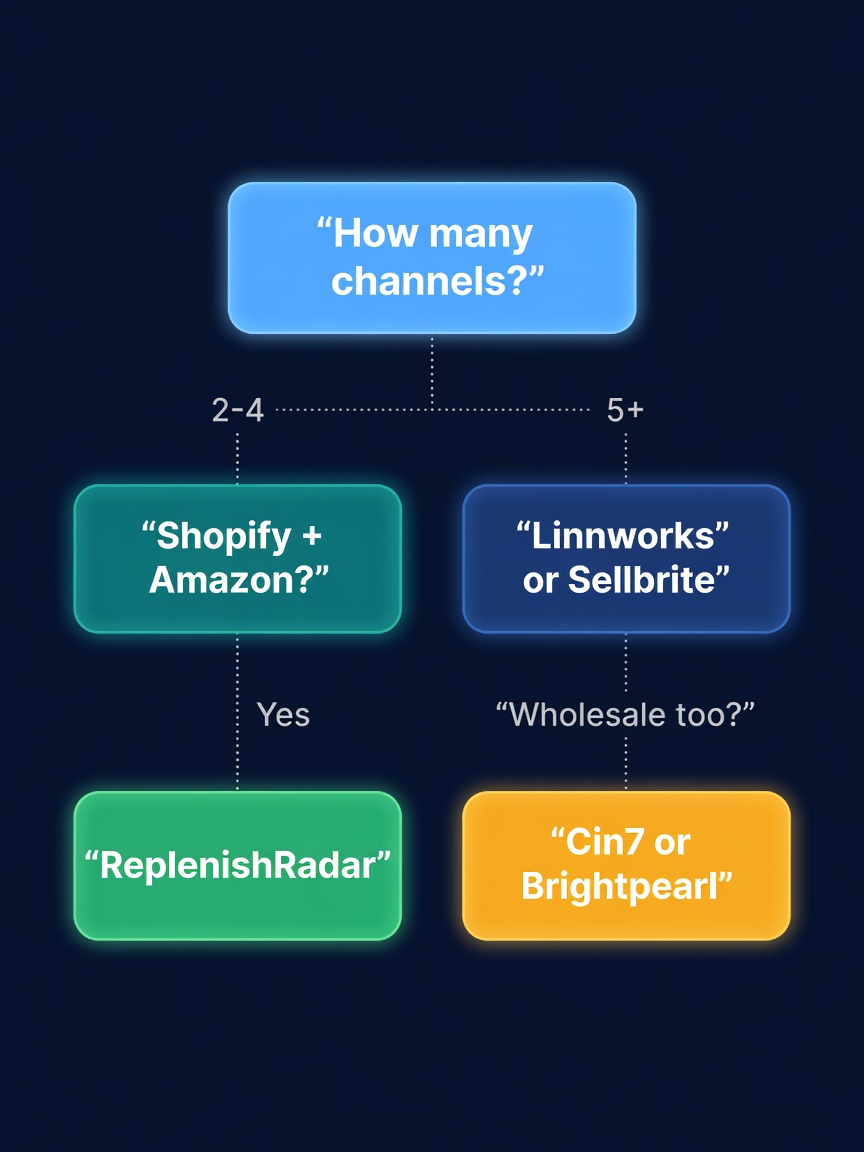
Two questions.
How many channels? Shopify plus Amazon, two to ten stores: ReplenishRadar is built for exactly that. Five or more marketplaces with eBay, Etsy and Walmart in the mix: Linnworks or Sumtracker for the sync. Wholesale or physical retail in the mix: Cin7 or Brightpearl for the B2B side.
Forecasting or counts? If the sentence in your head is "my counts do not match across channels", you need sync, and Sumtracker, Zoho, Sellbrite or Linnworks fix it. If it is "I keep stocking out because I do not know when to reorder or how much", you need forecasting, and that is ReplenishRadar, Inventory Planner or Sumtracker's Replenish plan.
For most Shopify plus Amazon sellers carrying 50 to 2,000 products, ReplenishRadar does both jobs in one system: connects both platforms natively, forecasts the combined demand, writes the purchase order, and tells you what to send to FBA and when.
Try ReplenishRadar free for 14 days
Related Reading:
Frequently Asked Questions
Get notified when it matters
Amazon and Shopify change the rules constantly. We'll email you when something affects your business.
See what your inventory is really doing
Doing $5M+ in revenue? Talk to our team
Related Posts
Best Shopify Inventory Management Apps in 2026
10 Shopify inventory management apps compared on forecasting, purchase orders, Amazon support and real pricing, with a pick for every store size.
Best Amazon FBA Inventory Tools (2026)
Compare the best inventory management tools for Amazon FBA sellers. See features, pricing, and which solution helps prevent stockouts and manage restock limits.
Cin7 Alternatives (2026)
Five Cin7 alternatives compared on stated price, contract terms, Shopify and Amazon support and locations, with a pick for each reason people leave Cin7.
