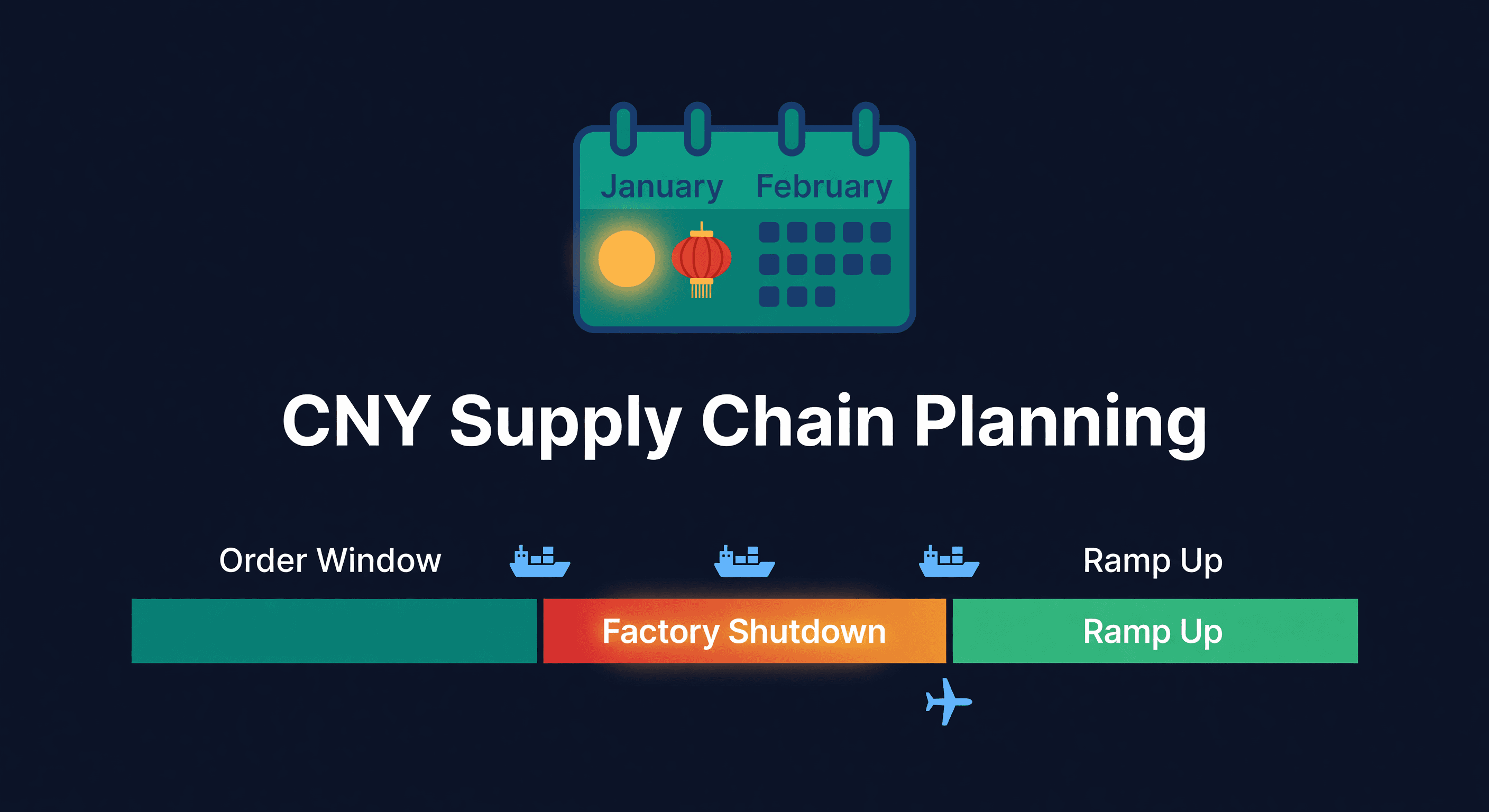
Chinese New Year Supply Chain Planning Guide
Key takeaway: Chinese New Year causes 5-6 weeks of supply disruption, not the 2 weeks factories officially close. Place final orders by mid-November and buffer 6-8 weeks of safety stock for your fastest-moving SKUs.
"My Supplier Said They Only Close for Two Weeks"
They probably do. Officially. The factory doors shut for 7-10 days around the Lunar New Year, and on paper everything reopens right after. Your supplier is not lying when they tell you this.
But I learned the hard way that the official closure and the effective closure are wildly different things. The first year I sourced from China, my supplier told me they would close January 25 through February 8 - 14 days. I planned for a two-week gap. My product ran out on February 20 and did not come back in stock until March 14. That was 22 days of stockout on my best seller, about $11,000 in lost revenue.
What happened? The shutdown is not 2 weeks. It is more like 5-6 weeks, and here is why.
The Real Timeline
CNY is a lunar holiday, so the dates shift each year. But the pattern is identical every year. I have tracked it across four suppliers over six years.
| Phase | Timing Relative to CNY | What Actually Happens |
|---|---|---|
| Pre-holiday slowdown | 2-3 weeks before | Workers start leaving for hometowns. Production capacity drops 30-50%. Quality issues increase as remaining staff rush orders. |
| Official holiday | 1-2 weeks | Factory closed. No production. No shipping. No communication. |
| Ramp-up period | 2-3 weeks after | Factory "reopens" but 20-40% of workers have not returned. Some never do - they find new jobs closer to home. New workers need training. |
| Full production | 4-6 weeks after CNY | Factory is genuinely back to normal capacity. |
That means the effective disruption window is 5-8 weeks, not 2. Plan for 2 weeks and you will stock out. I guarantee it.
The October Planning Calendar
If you are reading this and CNY is 4 or more months away, you are in good shape. If it is less than 8 weeks away, you are already late. Here is the timeline I follow:
October: Forecast and calculate. Pull your sales data for January through March. Calculate your average weekly demand for the products you source from China. Multiply by the number of weeks you need to cover (normal lead time + 4-6 week CNY buffer). That is your order quantity.
CNY Buffer Order = Weekly Demand x (Normal Lead Time + CNY Shutdown Weeks)
If you sell 80 units per week, your normal lead time is 5 weeks, and you are planning for a 5-week CNY disruption:
80 x (5 + 5) = 800 units
Subtract what you already have on hand and in transit. If you have 300 units, you need to order 500.
November: Place orders. This is the latest you should be placing production orders. November gives your supplier 8-10 weeks before the pre-holiday slowdown begins. Ask for a production schedule and confirm your slot. Suppliers are juggling hundreds of buyers all trying to get orders in - first come, first served.
December: Confirm and ship. Your goods should be in production or already manufactured by early December. Confirm shipment dates. Book freight early. Ocean freight rates spike 20-40% in December and January because everyone is trying to move cargo before the shutdown.
One thing I always do in December: get written confirmation from my supplier that my order will ship before they close. "In production" is not the same as "shipped." I have had orders that were "almost done" on December 20, then sat on the factory floor until mid-February.
January: Monitor. If your goods are not on a ship by mid-January, they are probably not shipping until after CNY. At this point, pivot to contingency planning - adjust ad spend, manage pricing, or source emergency inventory domestically if possible.
Quality Issues Before CNY
This one catches sellers off guard. The 2-3 weeks before CNY, when the factory is rushing to complete as many orders as possible before shutdown, is the highest-risk period for quality defects.
Workers are fatigued. Some have already left and the remaining staff is covering for them. Production is faster than normal because the factory is trying to clear its backlog. QC standards slip.
I had a pre-CNY shipment once where 8% of units failed my inspection - triple my normal defect rate. The cost of returns, refunds, and negative reviews on Amazon was worse than a stockout would have been.
My rules for pre-CNY orders:
- Request a pre-shipment inspection from a third-party QC company ($200-$400, worth every dollar)
- Do not accept "we will ship the day before we close" - that is the riskiest shipment of the year
- If your supplier is rushing to finish your order in the final week, delay shipment until after CNY opens. Better to receive late than to receive defective.
Freight During CNY Season
Shipping costs are part of the equation. Ignore them and your "smart" pre-CNY planning gets expensive fast.
| Freight Factor | Normal Period | CNY Season (Dec-Jan) |
|---|---|---|
| Ocean freight rates (per CBM) | $40-$80 | $60-$120 |
| Air freight rates (per kg) | $4-$7 | $6-$12 |
| Transit time reliability | Normal | Delays common (port congestion) |
| Container availability | Good | Tight (book 3-4 weeks early) |
If you are shipping a full container (20 CBM) and rates go from $50 to $90 per CBM, that is an extra $800 per shipment. Not catastrophic, but it adds up if you are splitting across multiple shipments.
Book freight by early December. After mid-December, you are competing with every importer in your market for the same containers.
Communicating with Your Supplier
Communication is where CNY planning either clicks or falls apart. Chinese business culture has different norms around directness, and the pre-holiday period is when miscommunication costs the most.
Be explicit about dates, not just instructions. "Please ship before CNY" is vague. "Please ship by January 10. If production will not be complete by January 8, notify me by December 20 so I can adjust my plan." That is a request your supplier can actually act on.
Send a WeChat message, not just an email. Most Chinese suppliers check WeChat constantly and email sporadically. If you are still communicating exclusively through email or Alibaba messaging, your messages during the busy pre-CNY period will sit unread for days. I switched to WeChat for urgent communications three years ago and response times improved dramatically.
Confirm everything twice. Once when you place the order. Again two weeks before their pre-holiday slowdown begins. Ask specifically: "Is my order in production? What percentage is complete? Will it ship before you close?" If the answers are vague, push harder. Vague answers in December become stockouts in February.
Send a holiday greeting. This sounds minor, but it matters. A brief message wishing your supplier a happy new year, ideally with a small red envelope (digital hongbao through WeChat) goes a long way. Supplier relationships in China are personal. The buyers who maintain good relationships get priority when production slots fill up.
Plan your post-CNY follow-up. Mark your calendar for the Monday after the official holiday ends. Message your supplier. Do not wait for them to reach out. Ask about their ramp-up schedule and confirm when your next order can start production. The sellers who follow up first get their orders queued first.
Alternative Sourcing During Shutdown
Some sellers ask: can I just buy from a non-Chinese supplier during CNY? Sometimes. But the transition is rarely smooth.
If you have an existing backup supplier in Vietnam, India, or Taiwan who already produces your product, yes - shift orders to them for the CNY window. But setting up a new supplier specifically to cover a 5-week gap is almost never worth the tooling costs, sample time, and quality risk. You would spend 3-4 months qualifying a new source to cover a problem that proper planning solves.
The exception: if your product is a commodity available from multiple sources (basic packaging supplies, generic components, unbranded goods), then sourcing domestically for one order cycle can work. The per-unit cost will be higher. But if the alternative is a 4-week stockout, the math may favor the expensive domestic order.
I keep a small domestic backup source for my top 3 SKUs. Not for regular orders - the unit cost is 35% higher. But I have used it twice during CNY emergencies, and both times the cost was less than the stockout cost.
Here is the math on one of those emergency orders:
| Factor | Normal (China) | Emergency (Domestic) |
|---|---|---|
| Unit cost | $6.80 | $9.20 |
| Shipping per unit | $1.50 | $0.40 |
| Order quantity | 500 | 200 |
| Total cost | $4,150 | $1,920 |
| Lead time | 5 weeks | 5 days |
The domestic order cost 35% more per unit. But I only ordered 200 units - enough to bridge the gap until my Chinese supplier came back online. The alternative was a 4-week stockout on a product doing $600/week in profit. That is $2,400 in lost profit versus $480 in extra unit cost. Not even close.
Adjusting Lead Times and Safety Stock in ReplenishRadar
The manual version of CNY planning is a spreadsheet exercise you do once a year in October, then forget about until the stockout hits in February. We built seasonal lead time adjustments into ReplenishRadar for exactly this reason. You set the shutdown window for each supplier - start date, end date, expected ramp-up period - and the system recalculates your reorder points and safety stock buffers to account for the extended lead time. PO suggestions shift earlier automatically. You do not need to remember to pad your orders because the math already includes the buffer.
Try ReplenishRadar free for 14 days ->
CNY Planning Is a Calendar Problem
The sellers who handle CNY well are not smarter or better funded. They just started earlier. October is when the thinking happens. November is when the ordering happens. December is when the shipping happens. January is too late for anything except damage control.
If you source from China and you are not building CNY into your annual inventory plan, you are choosing to stock out every February. The disruption is not a surprise. It is on the calendar. Treat it that way.
One number to remember: plan for 5 weeks of shutdown, not 2. If you end up with a few extra weeks of supply in March, the carrying cost on that buffer is a fraction of the revenue you would lose from a stockout. That math never changes.
Related Reading:
Frequently Asked Questions
Get notified when it matters
Amazon and Shopify change the rules constantly. We'll email you when something affects your business.
See what your inventory is really doing
Doing $5M+ in revenue? Talk to our team
Related Posts

Supplier Lead Time: How to Track, Reduce, and Plan Around It
Lead time drives every reorder decision. Learn how to measure it, reduce it, and build it into your inventory planning so you stop running out of stock.
Amazon's 2027 Bundle Rule and Your Kitted Inventory
Amazon's bundle policy changes January 11, 2027. Here's how to plan kitted FBA inventory, the reorder to skip, and the exemptions that keep a bundle live.
How to Create a Purchase Order (Step-by-Step)
How to create a purchase order for e-commerce, with a PO template, worked examples, and the ordering mistakes that cost sellers thousands.
