
Supplier Lead Time: How to Track, Reduce, and Plan Around It
Key takeaway: Don't trust supplier lead time quotes. Measure actual PO-to-receipt dates across your last 10 orders. The standard deviation of your lead time data directly feeds safety stock calculations. High lead time variability is the top cause of unexpected stockouts.
Lead Time Controls Everything Downstream
When sellers run out of stock, the post-mortem almost always lands in the same place: they ordered too late. And ordering too late usually means they underestimated how long it takes to get inventory from a supplier to a shelf.
I have a supplier who "always ships in three weeks." Except when you measure actual PO data, the range is 16 to 31 days depending on backlog, the season, and apparently the phases of the moon. Planning around the quoted three weeks is how you stockout.
Lead time is not a single number. It is a chain of steps, each with its own variability, and getting it wrong ripples through every inventory decision you make.
What Lead Time Actually Includes
Most sellers think of lead time as "shipping time." That is one component:
| Component | Typical Range | What Happens |
|---|---|---|
| Order processing | 1-5 days | Supplier confirms, schedules production |
| Manufacturing | 5-30 days | Product is made or assembled |
| Shipping prep | 1-3 days | Packaging, palletizing, export docs |
| Transit (domestic) | 3-7 days | Ground freight within the same country |
| Transit (ocean) | 18-35 days | Port to port, varies by route |
| Customs and port | 2-10 days | Clearance, inspections, drayage |
| Receiving and QC | 1-5 days | Unload, count, inspect, shelve |
| FBA processing | 5-14 days | If sending to Amazon fulfillment centers |
Example - overseas supplier to FBA:
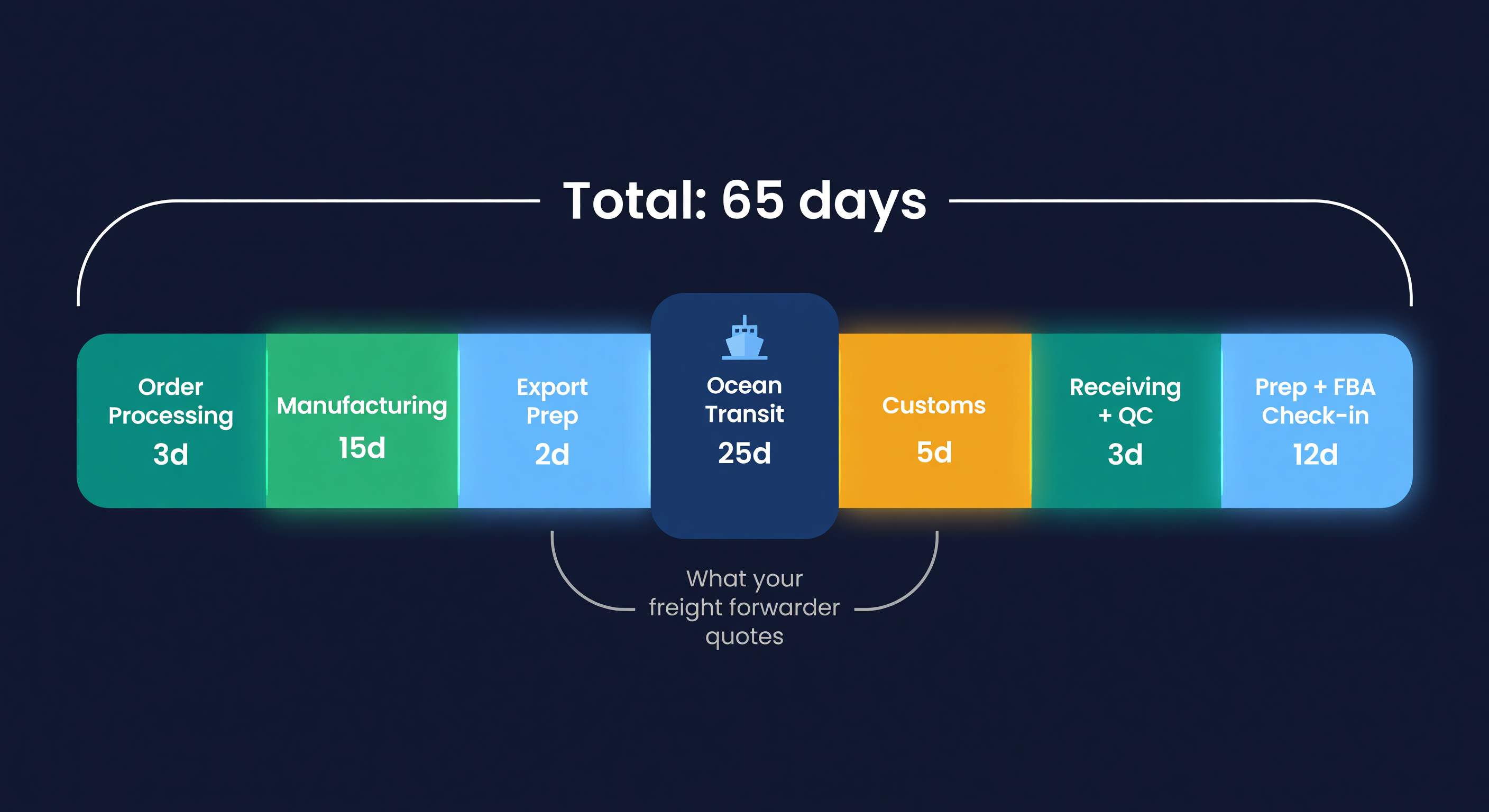
Order processing: 3 days + Manufacturing: 15 days + Export prep: 2 days
Ocean transit: 25 days + Customs: 5 days + Receiving: 3 days
Prep and ship to FBA: 2 days + FBA check-in: 10 days
Total Lead Time: 65 days
That 65-day number is what you plan around - not the 25-day ocean transit your freight forwarder quotes.
Why Lead Time Is a Direct Multiplier
Your reorder point formula is:
Reorder Point = (Average Daily Sales x Lead Time) + Safety Stock
If you sell 15 units per day:
| Lead Time | Lead Time Demand | Safety Stock (14 days) | Reorder Point |
|---|---|---|---|
| 10 days | 150 units | 210 units | 360 units |
| 30 days | 450 units | 210 units | 660 units |
| 50 days | 750 units | 210 units | 960 units |
| 70 days | 1,050 units | 210 units | 1,260 units |
Get the lead time wrong by two weeks and you will either stockout or carry excess inventory worth thousands of dollars. There is no third option.
How to Measure It
Supplier quotes are a starting point, not a measurement. For every purchase order, capture the PO submitted date, ship date, arrival date, and available-to-sell date. Then calculate:
Actual Lead Time = Available Date - PO Submitted Date
After 5-10 POs, build a profile. Here is a real example across 8 orders from one of our suppliers:
| PO | Lead Time (days) |
|---|---|
| PO-001 | 32 |
| PO-002 | 28 |
| PO-003 | 35 |
| PO-004 | 30 |
| PO-005 | 41 |
| PO-006 | 29 |
| PO-007 | 33 |
| PO-008 | 30 |
Average: 32 days. Standard deviation: 4.1 days. Range: 28-41 days.
That 41-day outlier matters. Planning for 28 days because "that's the best case" guarantees stockouts.
How Variable Lead Time Affects Safety Stock
Lead time variability feeds directly into safety stock calculations:
Safety Stock = Z x sqrt(L x sigma_d^2 + d^2 x sigma_L^2)
| Scenario | Avg Lead Time | Lead Time Std Dev | Safety Stock Needed |
|---|---|---|---|
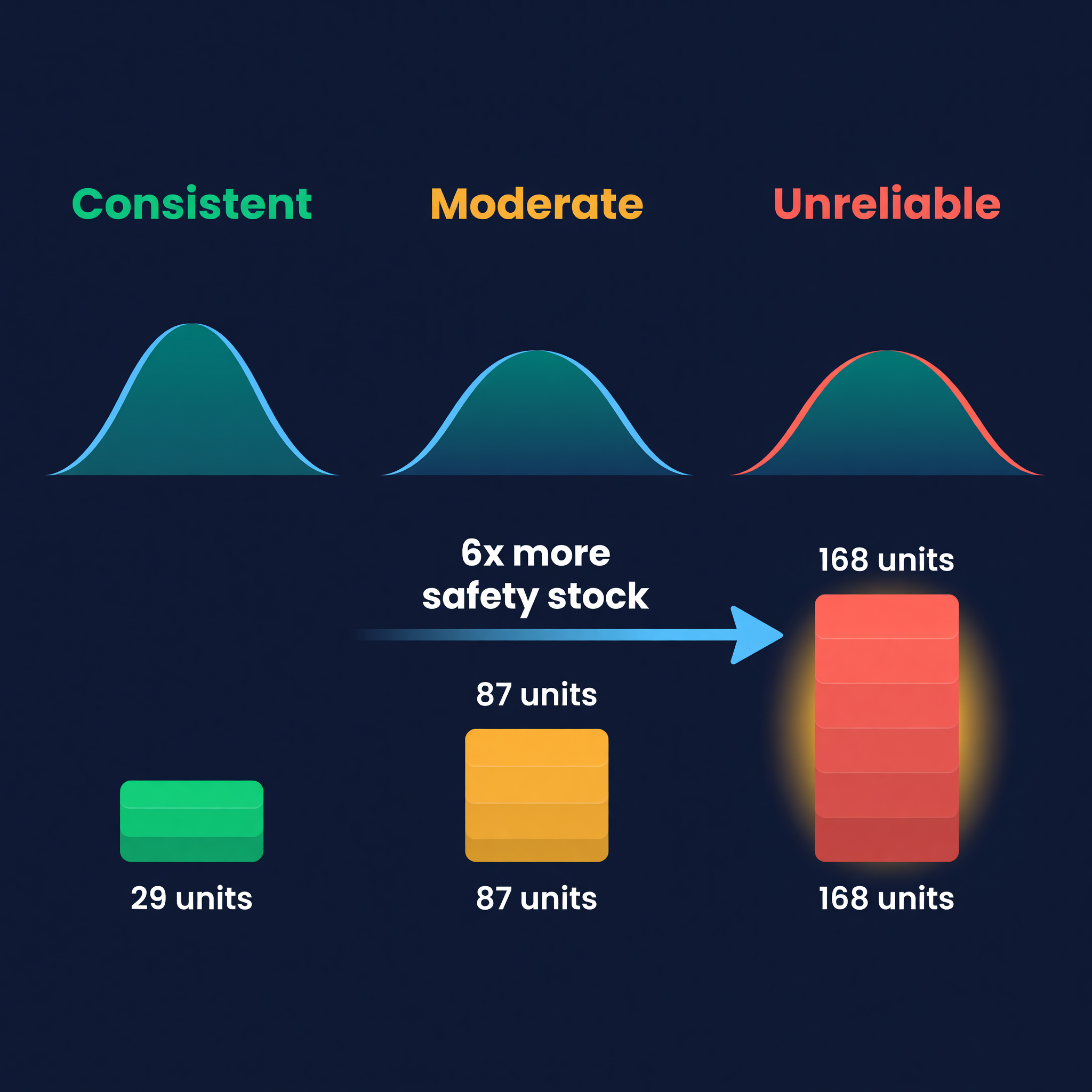
| Consistent supplier | 30 days | 1 day | 29 units |
| Moderate variation | 30 days | 5 days | 87 units |
| Unreliable supplier | 30 days | 10 days | 168 units |
Assumes 95% service level, 10 units/day, demand SD = 3.
Same average lead time in all three rows. But the unreliable supplier forces nearly 6x the safety stock. That is real cash tied up because of supply inconsistency.
Strategies to Reduce Lead Time
Negotiate faster processing. Many suppliers batch orders weekly. Ask for priority processing, standing production slots, or pre-approved orders that skip confirmation. Saves 2-5 days.
Pre-position raw materials. Arrange for the supplier to hold components in advance. You pay for materials upfront but cut manufacturing time by 5-15 days.
Dual-source your critical SKUs. Maintain a primary overseas supplier ($4.20/unit, 50-day lead time) and a domestic backup ($6.80/unit, 8-day lead time). The $2.60 premium is cheaper than a stockout costing $500/day in lost sales.
Use air freight selectively. For a SKU selling 20 units/day at $8 margin, switching one shipment from ocean (25 days) to air (4 days) yields 21 extra selling days - $3,360 in margin vs. $2,300 in extra shipping. Net benefit: $1,060.
Cut your receiving time. Pre-label cartons, schedule dock appointments, use barcode scanning. Saves 1-3 days. This one is entirely within your control.
When You Cannot Change Lead Time
Sometimes you are stuck with a 60-day lead time and no alternatives. In that case, manage around it:
- Smaller orders every 30 days instead of one large order every 90 reduces forecast risk
- With a 60-day lead time, update demand projections weekly as new sales data comes in
- For lead times over 30 days, review inventory levels on a calendar rather than waiting for the reorder point trigger
| Lead Time | Review Frequency |
|---|---|
| 7-14 days | Weekly |
| 15-30 days | Every 2 weeks |
| 31-60 days | Weekly |
| 60+ days | Twice weekly |
Notice the pattern reverses after 30 days. Longer lead times need more frequent reviews, not fewer, because the cost of being wrong is higher.
Automating Lead Time Tracking
The manual version of this - logging every PO date, calculating averages, updating your spreadsheet, hoping you did not fat-finger a cell - takes about four hours a month per supplier. I know because I used to do it.
We track this automatically in ReplenishRadar. Every PO you close updates the running average and standard deviation for that supplier. When the numbers drift - say your supplier quietly slips from 21 days to 28 - your reorder points adjust before you notice the problem. No spreadsheet to remember to update. The EOQ calculations factor in lead time too, so order quantity recommendations stay grounded in reality. An AI agent can take this a step further and draft purchase orders automatically using your tracked lead times, so reorders happen on day one of the risk window instead of day three.
Every day you shave off lead time lowers your reorder point, reduces safety stock, and frees up working capital. Measure it, reduce what you can, and build safety stock around what you cannot.
Try ReplenishRadar free for 14 days -> and see your actual lead times calculated from PO history.
Related Reading:
Frequently Asked Questions
Get notified when it matters
Amazon and Shopify change the rules constantly. We'll email you when something affects your business.
See what your inventory is really doing
Doing $5M+ in revenue? Talk to our team
Related Posts
How to Create a Purchase Order (Step-by-Step)
How to create a purchase order for e-commerce, with a PO template, worked examples, and the ordering mistakes that cost sellers thousands.
Tariffs and Inventory Strategy in 2026
How Section 301 tariffs, de minimis changes, and tariff uncertainty affect your inventory buying decisions. Pre-buy math, supplier diversification, and safety stock adjustments.
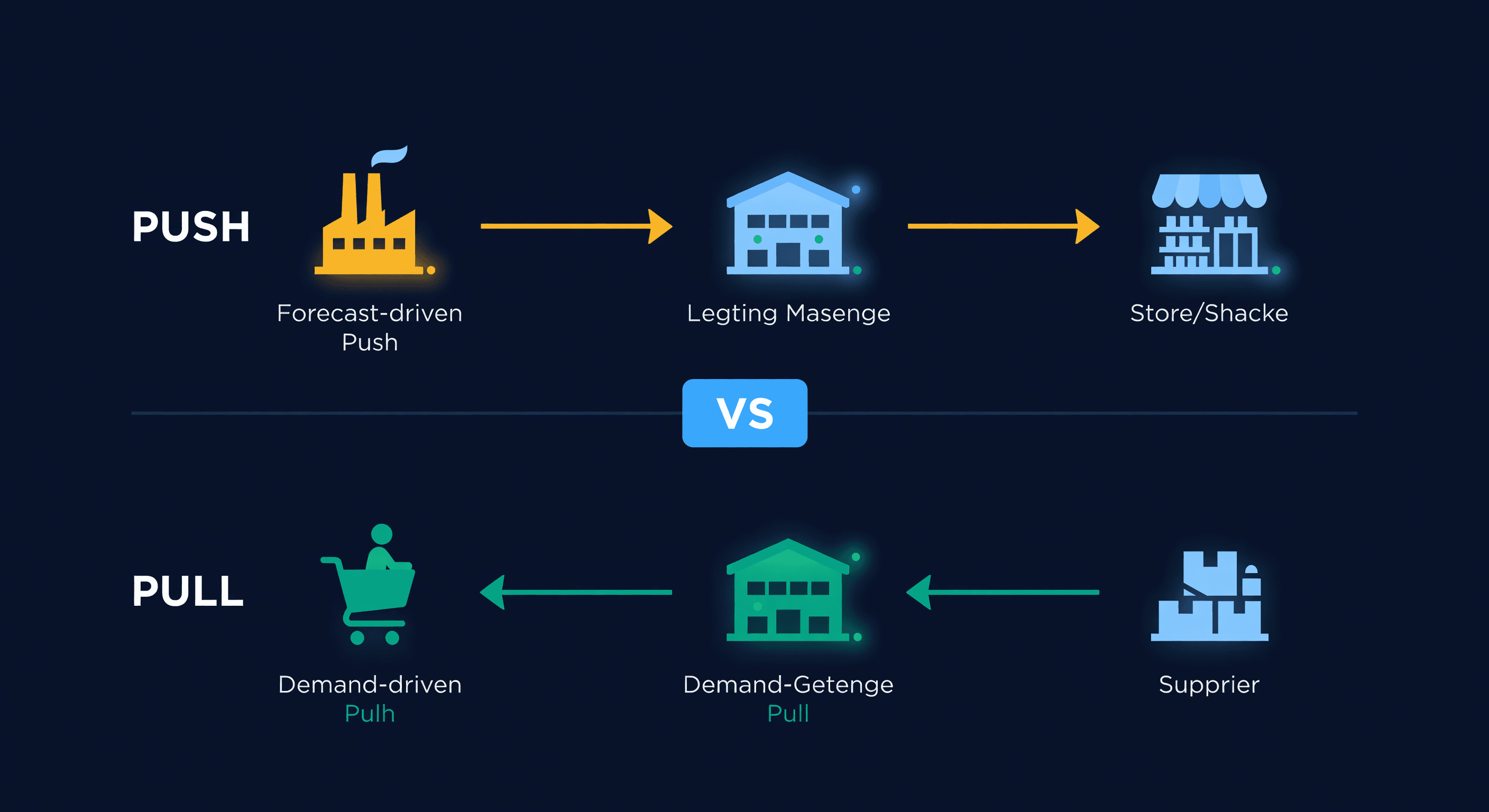
Pull vs Push Inventory: Which Model Wins?
Push inventory relies on forecasts. Pull inventory responds to demand. Most e-commerce sellers need both. Here's how to decide.
