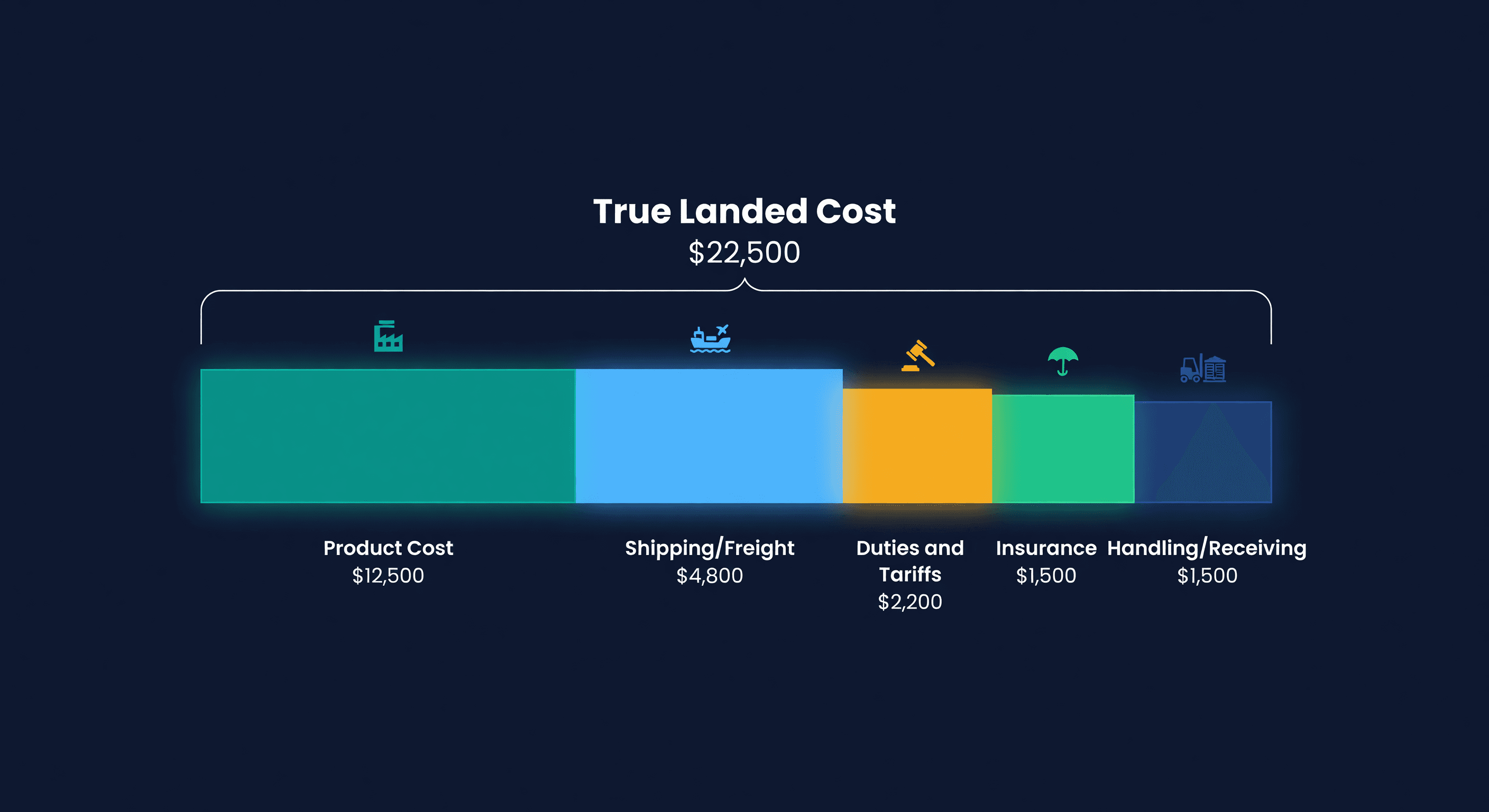
How to Calculate True Landed Cost
Key takeaway: Landed cost = product cost + freight + duties + tariffs + insurance + brokerage + handling, divided across the units in the shipment. In this post's illustrative 500-unit import, a $10.00 invoice price becomes $16.43 landed. A charge you have not been billed for yet is unknown, not zero.
Your Supplier Invoice Is Lying to You
Not maliciously. But if you are using the price on your purchase order as your product cost, every margin calculation you run is wrong.
Say your supplier charges $10 per unit and you sell at $29.99. On invoice price, gross margin looks like 67%. Now add freight, duties, insurance, customs brokerage, and the labor to receive the shipment, and suppose the real cost per unit comes to $14.20. Gross margin is 53%.
Run a 20% promotion at $23.99 and the invoice math says you keep 58% of the price. The landed math says 41%. Those are two different businesses, and only one of them is yours.
Landed cost is the total cost to get one unit from your supplier's dock to your warehouse shelf. Everything between "I placed the order" and "it is on the shelf ready to sell" counts.
What Landed Cost Actually Includes
Here is every cost category, with typical ranges for imported consumer goods:
| Cost Component | Typical Range | Notes |
|---|---|---|
| Product cost (FOB) | The invoice price | Your starting point, not your ending point |
| Ocean freight | $0.50-$4.00/unit | Varies wildly by volume and season |
| Domestic trucking | $0.20-$1.00/unit | Port to warehouse |
| Duties and tariffs | 0%-25% of product cost | Depends on HTS code and country of origin |
| Customs brokerage | $150-$300/shipment | Fixed fee, amortize across units |
| Insurance | 0.5%-2% of goods value | Often forgotten |
| Inbound handling | $0.15-$0.50/unit | Receiving, counting, shelving |
| Inspection fees | $200-$500/shipment | If you use third-party QC |
Some of these are per-unit costs. Others are per-shipment costs that you need to divide by the number of units. That distinction matters more than people realize. A $300 customs brokerage fee is $0.60 per unit on a 500-unit shipment but $3.00 per unit on a 100-unit shipment.
The Formula
Landed cost per unit is straightforward once you have the numbers:
Landed Cost = (Product Cost + Per-Unit Freight + Per-Unit Duties) + (Shipment Costs / Units in Shipment)
Here is an illustrative example. Say you are importing a product from China:
| Line Item | Amount |
|---|---|
| Product cost (FOB) | $10.00 x 500 units = $5,000 |
| Ocean freight (FCL) | $1,800 |
| Domestic trucking | $400 |
| Duties (7.5% on $5,000) | $375 |
| Customs brokerage | $250 |
| Insurance (1% of $5,000) | $50 |
| Third-party inspection | $300 |
| Inbound receiving labor (2 hrs @ $20/hr) | $40 |
| Total shipment cost | $8,215 |
Landed cost per unit = $8,215 / 500 = $16.43
Your supplier invoice says $10.00. Your real cost is $16.43. That is a 64% markup before you have sold a single unit. If your selling price is $34.99, your actual gross margin is 53%, not the 71% you calculated from the invoice price alone.
A Four-Unit Order, Line by Line
The 500-unit example has every bill in hand. Real orders often don't, and a small order makes the problem easy to see.
Illustrative assumptions: these are synthetic numbers, not a real supplier invoice. Every amount is in US dollars.
| Line | Per Unit | Order Total |
|---|---|---|
| Item cost, 4 units | $16.76 | $67.04 |
| Freight (entered) | $5.00 | $20.00 |
| Duty (entered) | $1.00 | $4.00 |
| Added charges (freight + duty) | $6.00 | $24.00 |
| Landed cost | $22.76 | $91.04 |
$16.76 is the item cost. It is not a supplier quote. It is a number picked for the arithmetic. And it is not the landed cost either, because nothing has moved yet. Add $20 of freight and $4 of duty, spread across 4 units, and each unit carries $6 more. That gives $22.76 landed per unit and $91.04 for the order.
Now say the customs brokerage bill for this order has not arrived. The temptation is to type $0 in that cell. Don't. A missing charge is unknown, not zero. Put $0 in and $22.76 looks like a finished number when it is a partial one. Leave the cell blank and mark the landed cost as incomplete until the bill comes in.
I keep four kinds of number in separate columns, and I would not merge any two of them:
- Product cost. The item cost per unit on the order. $16.76 here.
- Entered freight and duty. What you typed in when you placed the order, usually from a forwarder's estimate or the last shipment. $20 and $4 here.
- Amazon fee estimates. FBA fulfillment and referral fees are charged when a unit sells, so they belong to selling cost rather than landed cost. Keep them beside it for margin math, and keep calling them estimates until they show up on a settlement.
- Invoiced actuals. The freight, duty and brokerage bills once they arrive. They replace the entered figures. They do not get added on top.
Mix these and a margin report can count freight twice (the estimate and the invoice) or not at all (the bill nobody has opened).
Why This Wrecks Your Reorder Math
I used to wonder why my bank balance never matched my profit projections. This was a big reason. Every downstream calculation that uses "cost" is wrong if you are using invoice cost instead of landed cost.
Here is where it hurts most:
Gross margin. If you think your margin is 71% but it is really 53%, you will approve promotions and discounts that actually lose money. A 25% off sale at $26.24 looks fine against a $10 cost (62% margin). Against a $16.43 landed cost, your margin drops to 37%. Still profitable, but barely.
Reorder quantity. EOQ calculations use cost per unit as an input. Underestimate your cost and EOQ tells you to order smaller quantities more often, because it thinks holding cost is lower than it actually is.
Working capital planning. If each unit really costs $16.43 but you are budgeting $10, a 500-unit order needs $8,215, not $5,000. Budget on invoice cost and you can run out of working capital mid-order, because the freight bill comes due separately.
Profitability by SKU. Some of your products have higher landed cost ratios than others. A bulky, heavy item from overseas might land 70% above its invoice price while a small, light item shipped domestically might be only 5% above. Treating them the same means you think the heavy item is more profitable than it actually is.
The Five Costs Sellers Forget
These five drop out of spreadsheet calculations because each one arrives on a different bill from the product. Roughly largest first:
Inbound freight per unit. This is the big one. Sellers track the product cost on the PO but pay freight separately, sometimes weeks later. It never makes it into the per-unit cost. On imported goods it is often the largest line after the product itself, as it is in the 500-unit example above.
Duties and tariffs. These change. When the Section 301 tariffs on Chinese-origin goods arrived in 2018 and 2019, many products picked up an extra 25% on top of their normal duty rate. If you set your duty rate once and never updated it, your landed cost is wrong.
Customs brokerage. It is a flat fee per shipment, usually $150 to $300. Easy to forget because it does not appear on the supplier invoice or the freight invoice. It is a separate bill from your broker. On small shipments, it adds meaningful per-unit cost.
Insurance. Most sellers either self-insure without realizing it or pay for insurance and forget to include it in cost calculations. At 1% of goods value, it is small per shipment but real over a year.
Receiving labor. Someone has to unload, count, inspect, and shelve the product. Whether that is your time or an employee's time, it has a cost. Two hours of warehouse labor at $20/hour on a 500-unit shipment is only $0.08 per unit. On a 50-unit shipment, it is $0.80.
How Shipment Size Changes the Math
This is where landed cost connects directly to your order quantity decisions. Fixed costs per shipment (brokerage, inspection, trucking minimum charges) get divided across fewer units on small orders.
Illustrative assumptions: $10.00 product cost per unit and $990 of fixed costs per shipment.
| Shipment Size | Fixed Costs per Shipment | Fixed Cost per Unit | Product Cost per Unit | Landed Cost per Unit |
|---|---|---|---|---|
| 100 units | $990 | $9.90 | $10.00 | $19.90 |
| 250 units | $990 | $3.96 | $10.00 | $13.96 |
| 500 units | $990 | $1.98 | $10.00 | $11.98 |
| 1,000 units | $990 | $0.99 | $10.00 | $10.99 |
The product costs exactly the same. But your landed cost per unit drops 45% from a 100-unit order to a 1,000-unit order. That is why the cash flow impact of inventory decisions is so hard to reason about. You are not just choosing how many units to buy. You are choosing your per-unit cost.
Of course, bigger orders tie up more cash. A 1,000-unit order at $10.99 per unit costs $10,990 but a 100-unit order at $19.90 costs only $1,990. The per-unit savings have to be weighed against the carrying cost and cash lockup. This is exactly the tradeoff that EOQ tries to balance.
Tracking Landed Cost Over Time
Landed cost is not a number you calculate once. Freight rates move with the season and with how full the ships are. Tariff rates change with policy.
I recalculate after every shipment. Here is a simplified tracking approach:
- Create a row per shipment (not per SKU per shipment, keep it manageable)
- Log every cost component with receipts, and leave a blank, not a zero, for any bill that has not arrived
- Divide total cost by units received
- Compare to the previous shipment's landed cost
If your landed cost jumps more than 10% between shipments, figure out why. Usually it is freight. Sometimes it is a duty rate change you missed. Occasionally it is because you ordered a smaller quantity and the fixed costs per unit went up.
Landed Cost by Product Category
Not every product category has the same landed cost multiplier.
Illustrative assumptions: the multipliers below are rough planning ranges, not measured averages. Check them against your own shipments.
| Product Category | Typical Landed Cost Multiplier | Biggest Cost Driver |
|---|---|---|
| Small electronics (China) | 1.35-1.55x | Duties (often 3-8%) + freight |
| Apparel (Vietnam/Bangladesh) | 1.25-1.45x | Duties (15-32%) dominate |
| Home goods (China) | 1.40-1.65x | Freight (bulky, heavy) |
| Supplements (domestic US) | 1.05-1.15x | Minimal duties, low freight |
| Toys/games (China) | 1.30-1.50x | Duties vary widely by material |
The domestic products stand out. With a US supplier you skip ocean freight, import duties and customs brokerage, so the multiplier drops. That is one reason domestic sourcing can compete at a higher per-unit price. A $12 domestic product at 1.10x lands at $13.20. An $8 import at 1.55x lands at $12.40. The import still wins by $0.80 per unit, but the domestic supplier ships in 5 days instead of 45, and that is 40 fewer days of cash sitting on the water.
Set Up Your Own Landed Cost Tracker
If you are not ready for software, start with a spreadsheet. Seriously. Even a rough landed cost calculation is better than using invoice price. Pull up your last three shipments, add every cost you can find (freight invoices, duty receipts, brokerage bills) and divide by units. Where a bill is missing, say so in the row instead of guessing.
Expect the number to be higher than the invoice price by more than you would guess. In the illustrative 500-unit example above, it ran 64% over. Once you see your real number, every pricing decision, promotion, and reorder calculation you make from it gets more accurate.
That is not a small thing. That is the difference between thinking you made money and actually making money.
We built ReplenishRadar for sellers who do their reorder math across Shopify and Amazon. Try ReplenishRadar free for 14 days ->
Related Reading:
Frequently Asked Questions
Get notified when it matters
Amazon and Shopify change the rules constantly. We'll email you when something affects your business.
See what your inventory is really doing
Doing $5M+ in revenue? Talk to our team
Related Posts
How Much Inventory Should You Carry?
The formula for optimal inventory levels, carrying cost math, and a worked example for a $500K inventory business. Stop guessing, start calculating.
7 Inventory Mistakes That Kill Cash Flow
The 7 most common inventory management mistakes that drain cash. Real numbers on what each one costs and how to fix it.
Working Capital and Inventory: Improve E-commerce Cash Flow
How inventory ties up working capital and what to do about it. Reduce tied-up cash while keeping products in stock across Shopify and Amazon.
