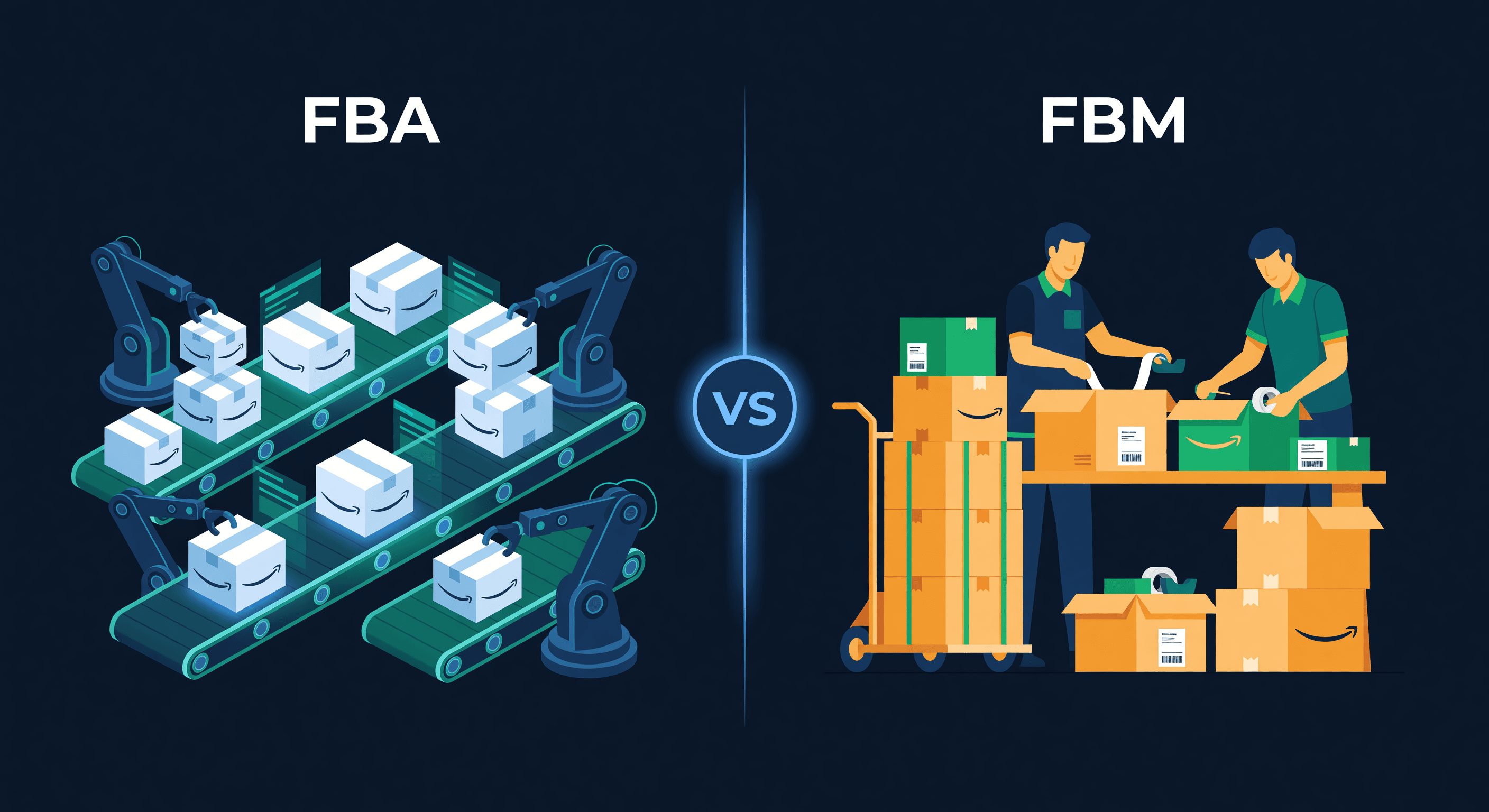
Amazon FBA vs FBM: Inventory Planning Guide
The Wrong Way to Choose
Most sellers pick FBA or FBM based on vibes. "FBA is easier." "FBM gives me more control." Neither is a strategy. The right answer depends on exactly three numbers: your per-unit fulfillment cost under each model, your inventory turn rate, and your tolerance for complexity.
I have run both. Simultaneously. For over two years. Here is what I learned, and it is not what most Amazon advice will tell you.
The Real Cost Comparison
Everyone quotes FBA fulfillment fees like they are the whole story. They are not. You need to compare the total cost per unit sold, including the costs that show up on different invoices or do not show up at all.
Amazon also moved the fulfillment fee itself in 2026: standard-size fees have been split into price bands since January 15, and a 3.5% fuel and logistics surcharge has applied to every FBA fulfillment fee since April 17. The FBA fulfillment figure below is a round illustrative number, so look up your own SKU's price band and add the surcharge before you trust the crossover.
Illustrative assumptions, as of October 2026, for a product that weighs 1 lb, measures 10x8x4 inches, and sells for $29.99 (the FBA fulfillment fee, self-fulfillment labor and 3PL rates are estimates; the FBA storage line uses Amazon's published 2026 rate card):
| Cost Component | FBA | FBM (Self-fulfilled) | SFP (3PL, 2-day) |
|---|---|---|---|
| Pick, pack, and ship | $5.40 (Amazon fee) | $1.20 (labor) + $4.50 (shipping) = $5.70 | $5.50 (3PL w/ negotiated 2-day) |
| Packaging materials | $0 (included) | $0.60 | $0 (3PL includes) |
| Storage (30-day turn) | $0.22 | $0.15 (warehouse) | $0.18 (3PL warehouse) |
| Storage (90-day turn) | $0.66 | $0.45 | $0.54 |
| Inbound shipping to FBA | $0.40 | N/A | N/A |
| Returns processing | $0 (included) | $2.00 (avg) | $1.50 (3PL) |
| Total (30-day turn) | $6.02 | $6.45 | $7.18 |
| Total (90-day turn) | $6.46 | $6.30 | $7.54 |
At a 30-day turn, FBA wins by $0.43 per unit. At a 90-day turn, FBM wins by $0.16 per unit. The crossover happens around 60 days of inventory age. SFP runs higher per unit on this lightweight product, but the gap narrows on heavier items where FBA fulfillment fees jump to $12+. Cost per unit is not the only variable that matters, though.
Where FBA Wins, and It Is Not Close
Conversion rate. FBA listings with the Prime badge convert noticeably higher than FBM, because of the badge itself and the faster delivery promise.
On a product selling 50 units per month via FBM, switching to FBA might push you to 60-65 units. At a $10 margin per unit, that is an extra $100-$150 per month in gross profit. The conversion lift usually outweighs the cost difference.
Buy Box. If you compete with other sellers on the same listing, FBA sellers win the Buy Box more often. Amazon weights fulfillment method in the algorithm. Lose the Buy Box and it does not matter how cheap your fulfillment is. You are not selling anything.
Customer service. Amazon handles returns, refunds, and customer complaints for FBA orders. That is not free, but the time and stress it saves is real. I spent 8-10 hours per week on FBM customer service before switching my top sellers to FBA.
Multi-channel fulfillment. Amazon will fulfill your Shopify orders from FBA inventory too, though the fees are higher. It simplifies operations if you sell on both channels.
Where FBM Wins
Large and heavy products. FBA fees are calculated by size tier and weight.
A 5-lb product in an oversized box can cost $12-$18 per unit in FBA fees. If you can ship it yourself for $8-$10, that is a meaningful difference.
Slow movers. If a SKU sells 5 units per month, the inventory sitting in FBA racks up storage fees that quietly destroy your margin. After 181 days, Amazon charges aged inventory surcharges. After 271 days, those surcharges escalate. A slow-moving FBM product in your own warehouse costs a fraction of that.
Custom or fragile items. Anything that needs special packaging, kitting, or quality inspection before shipping is easier to handle yourself. Amazon's fulfillment centers process millions of units. They are fast but not gentle.
Products with high return rates. Amazon's FBA return processing is included in the fee, but returned inventory often comes back unsellable. FBM lets you inspect returns yourself and decide whether to restock, refurbish, or liquidate.
I have had products with 15% return rates where the FBM refurbish-and-relist process saved $2-$3 per returned unit.
Seller Fulfilled Prime: The Third Option
There is a third path that most FBA vs FBM guides skip. Seller Fulfilled Prime lets you ship from your own warehouse while displaying the Prime badge. You handle fulfillment. Amazon holds you to Prime delivery standards. Buyers see the same Prime logo and get the same delivery promise.
Amazon tightened SFP delivery-speed expectations for July 2026. You still need the operational basics: strong on-time delivery, low cancellation rates, valid tracking, and the ability to keep Prime promises without falling apart on Monday morning. Amazon also requires nationwide standard shipping coverage for SFP offers in the contiguous US, but that is not the same thing as saying every standard-size order must be delivered by ground in two days from one warehouse. The real filter is delivery promise math. If your only ship-from point is on one coast, hitting the faster Prime page-view thresholds usually means expensive air, a 3PL network, or a smaller SFP catalog.
Where SFP wins. Products where FBA fees are high but your 3PL can ship cheaper.
A 3 lb product costs around $8.70 per unit in FBA fulfillment fees. A 3PL with negotiated two-day rates might charge $6.20. At 800 units per month, that is roughly $2,000 in monthly fulfillment savings, and you avoid FBA's escalating storage fees entirely. SFP also works for products with slower turns where FBA aged inventory surcharges would quietly destroy your margin.
Where SFP fails. Small, lightweight products with high velocity. FBA's $5.40 per unit on a 1 lb item is hard to beat, and the operational simplicity of letting Amazon handle everything has real value. SFP also breaks down if you cannot consistently hit the delivery metrics. One bad week can get you suspended from the program, and re-enrollment is not guaranteed.
The inventory planning catch. This is where SFP gets tricky. SFP sellers cannot afford stockouts. With standard FBM, a stockout costs you sales and some search ranking. Annoying, but recoverable. With SFP, a stockout means cancelled Prime orders, cratered delivery metrics, and potential suspension. Amazon does not care why you ran out.
I would carry 25-30% more safety stock on SFP listings compared to standard FBM. The cost of holding extra inventory is nothing compared to losing your Prime badge and spending weeks re-qualifying for the program.
The Inventory Planning Difference
This is where the FBA vs FBM decision matters most for operations, and where most sellers underestimate the complexity.
FBA forces you to forecast and pre-position inventory. You are shipping products to Amazon's warehouses weeks before customers buy them. That means you need to predict demand 3-5 weeks out (your supplier lead time plus Amazon's inbound processing time). Get the forecast wrong in either direction and you are either stocked out or paying storage fees on excess.
FBM lets you react in real time. You ship when the order comes in. No forecasting required for fulfillment timing, though you still need enough stock on hand. The lead time is just your supplier lead time. You do not add Amazon's inbound processing window.
Here is how that looks in practice:
| Planning Factor | FBA | FBM |
|---|---|---|
| Effective lead time | Supplier + 2-4 weeks inbound | Supplier only |
| Safety stock needed | Higher (longer effective lead time) | Lower |
| Capital tied up in pipeline | More (inventory in transit + at FBA) | Less |
| Risk of stockout | Higher (restocking takes weeks) | Lower (can expedite from own stock) |
| Storage cost control | Limited (Amazon sets rates) | You negotiate your own lease |
| Inventory visibility | 24-48 hour delay in FBA reports | Real-time from your WMS |
We are talking about fundamentally different operating models. FBA is a bet-ahead model. FBM is a just-in-time model.
The Hybrid Approach
This is what I recommend for sellers with 50+ SKUs and at least $100K in annual revenue. Run FBA as your primary fulfillment for your top sellers and keep FBM active as a backup.
The setup works like this. Your top 20-30 SKUs by velocity go to FBA. These are the products where Prime badging and fast delivery matter most, and where the storage fees stay low because the inventory moves quickly. You maintain FBA restock limits and keep enough stock flowing to avoid gaps.
Your slow movers, oversized items, and long-tail SKUs stay FBM. You fulfill them from your own warehouse or 3PL. No storage fee surprises, full control over inventory aging.
The backup FBM listing on your top SKUs is the part most sellers miss. When your FBA stock runs out during a restocking cycle, and it will, the FBM listing catches the sales you would otherwise lose. You pay more per order for self-fulfillment, but a sale at lower margin is better than no sale and a tanked ranking.
I keep 2-3 weeks of FBM backup stock on my top 10 SKUs. It has saved me from ranking collapses at least four times.
When Storage Fees Flip the Math
FBA storage fees are the single biggest variable in this comparison. They are not static, and they are not kind to sellers who misjudge demand.
The monthly storage fee schedule:
| Period | Standard Size | Oversize |
|---|---|---|
| Jan-Sep | $0.78/cu ft | $0.56/cu ft |
| Oct-Dec | $2.40/cu ft | $1.40/cu ft |
| 181-210 days (aged) | $0.50/cu ft surcharge | $0.50/cu ft surcharge |
| 211-240 days (aged) | $1.00/cu ft surcharge | $1.00/cu ft surcharge |
| 241-270 days (aged) | $1.50/cu ft surcharge | $1.50/cu ft surcharge |
| 271-300 days (aged) | $5.45/cu ft surcharge | $5.45/cu ft surcharge |
| 301-330 days (aged) | $5.70/cu ft surcharge | $5.70/cu ft surcharge |
| 331-365 days (aged) | $5.90/cu ft surcharge | $5.90/cu ft surcharge |
| 366-455 days (aged) | $6.90/cu ft or $0.30/unit minimum | $6.90/cu ft or $0.30/unit minimum |
| 456+ days (aged) | $7.90/cu ft or $0.35/unit minimum | $7.90/cu ft or $0.35/unit minimum |
Illustrative assumptions: a product that occupies 0.5 cubic feet and turns over in 30 days costs $0.39/month in storage (Jan-Sep), using the rate card above. The same product sitting for 9 months costs $0.39 x 9 plus three monthly surcharge tiers, or roughly $5.00 total. Let it cross 300 days and the next two surcharge jumps make the bill ugly fast.
This is why inventory turn rate matters so much for FBA profitability. If your inventory turnover is below 6x per year, go through your FBA catalog SKU by SKU. Some of them belong in FBM.
Splitting Inventory Across FBA and Your Warehouse
The operational pain of a hybrid approach is tracking inventory in two places. You need to know how much is at FBA, how much is in your warehouse, how much is in transit, and how much you need to reorder. A spreadsheet can do this for 10 SKUs. At 50+ SKUs with both FBA and warehouse stock, it falls apart.
We built ReplenishRadar to track split inventory exactly this way. The system pulls your FBA stock levels from Amazon and your warehouse stock from Shopify or manual input, then shows a single view of total available inventory across all locations. When it generates a reorder suggestion or transfer recommendation, it accounts for what is already at FBA, what is in transit, and what the demand forecast says you will need. You do not have to reconcile two separate systems or guess whether your FBA send-in will arrive before you stock out.
The Decision Framework
I use a simple scoring system to decide FBA vs FBM for each SKU. It takes about 30 seconds per product once you have the data.
| Factor | FBA Score | FBM Score | How to Measure |
|---|---|---|---|
| Weight under 2 lbs | +2 | 0 | Product weight |
| Sells 30+ units/month | +2 | 0 | 90-day average |
| Sells under 10 units/month | 0 | +2 | 90-day average |
| Competes for Buy Box | +2 | 0 | Multiple sellers on listing? |
| Oversized tier | 0 | +2 | Check Amazon size tier |
| Return rate above 10% | 0 | +1 | Returns report |
| Needs special packaging | 0 | +2 | Fragile/custom? |
| Margin above 40% | +1 | 0 | Can absorb FBA fees |
| Margin below 20% | 0 | +1 | FBA fees may kill margin |
Score above 4 for FBA: send it to FBA. Score above 4 for FBM: keep it in-house. Close call: try FBA for 90 days and compare the numbers.
The point is not to be precise. The point is to stop guessing and start measuring. I have seen sellers agonize over this decision for months when a 90-day test would have given them the answer.
Pick a Strategy and Commit
Run FBA for your fast sellers, FBM for your slow and oversized products, SFP if you have the 3PL infrastructure to earn Prime without Amazon's fees, and hybrid for anything in the middle. Review the math quarterly. If a product's FBA storage costs exceed 15% of its selling price, move it to FBM or consider SFP. If an FBM product keeps losing the Buy Box to FBA competitors, move it to FBA.
The sellers who get into trouble are the ones who pick one model and never reevaluate. Your catalog changes. Amazon's fees change. The right answer today might be wrong in six months.
Related Reading:
Frequently Asked Questions
Get notified when it matters
Amazon and Shopify change the rules constantly. We'll email you when something affects your business.
See what your inventory is really doing
Doing $5M+ in revenue? Talk to our team
Related Posts
Cin7 Alternatives (2026)
Five Cin7 alternatives compared on stated price, contract terms, Shopify and Amazon support and locations, with a pick for each reason people leave Cin7.
Inventory Planner Alternatives (2026)
Eight real Inventory Planner alternatives compared on price, contract terms, Amazon support and setup time, with a pick for each reason people leave.
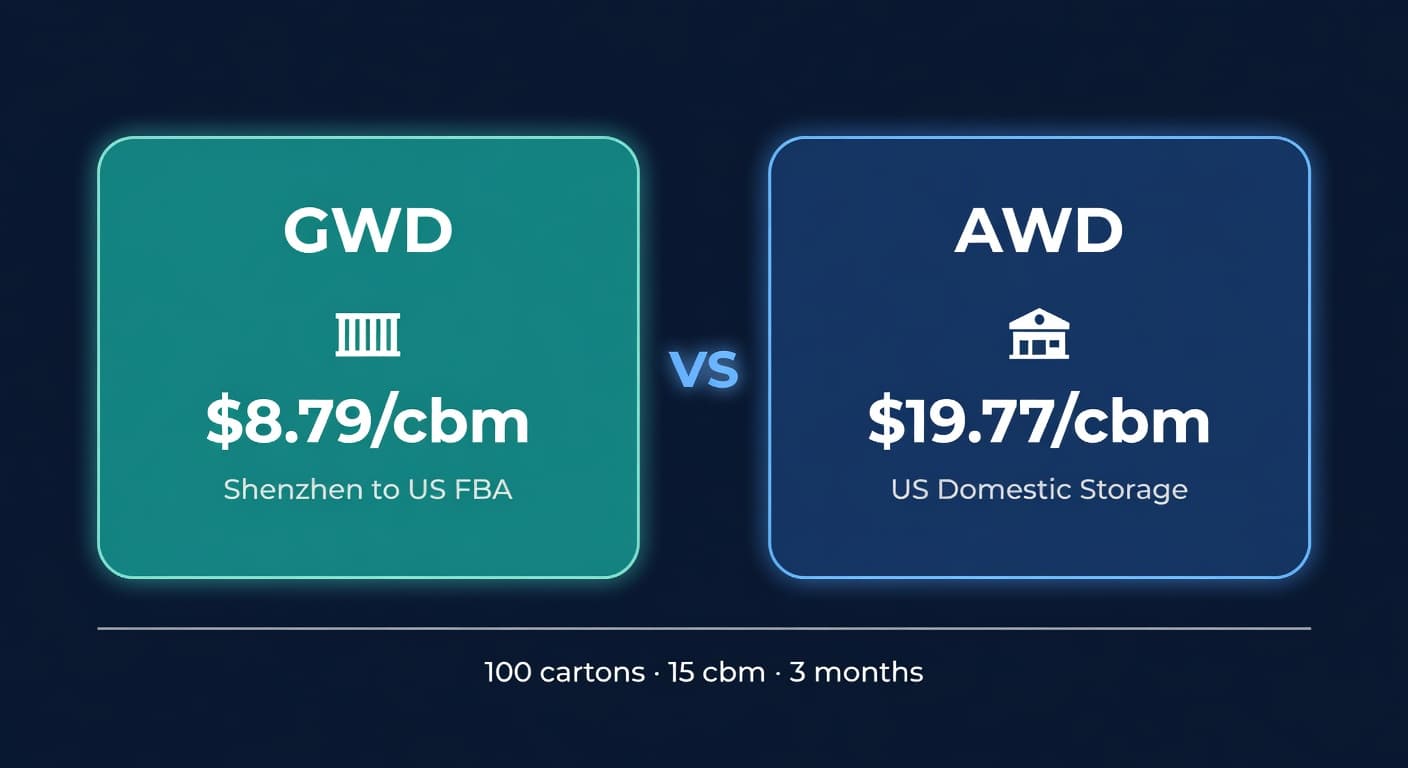
Amazon GWD: Fee Math, Pipeline Risk, and Who It Fits
Amazon's new Global Warehousing and Distribution program stores inventory in Shenzhen. Here's the real cost breakdown and what sellers should watch for.
