Amazon's New 3.5% FBA Surcharge: Per-Unit Math

Amazon added a 3.5% surcharge to every FBA fulfillment fee on April 17, 2026. Not to referral fees. Not to storage. Just fulfillment. They are calling it temporary. There is no end date.
I have seen this before. In April 2022, Amazon added a 5% "fuel and inflation surcharge." That one never got removed either. It was quietly absorbed into the permanent fee structure during the next round of annual increases. Expect the same here.
Here is what it actually costs you, with the math.
What the Surcharge Is
The 3.5% applies on top of your existing FBA fulfillment fee. That is the per-unit fee Amazon charges to pick, pack, and ship your product. If your fulfillment fee is $4.82, you now pay $4.82 plus 3.5% of $4.82. Not 3.5% of your sale price. Not 3.5% of your total fees. Just the fulfillment portion.
Amazon's stated reason: elevated fuel and logistics costs driven by global oil prices above $111 per barrel. They say they absorbed cost increases as long as they could. Similar language to 2022.
Timeline:
- April 17, 2026 - FBA orders in the U.S. and Canada, plus Remote Fulfillment with FBA (shipping to Canada, Mexico, Brazil)
- May 2, 2026 - Buy with Prime and Multi-Channel Fulfillment in the U.S. and Canada
If you use MCF to fulfill non-Amazon orders through FBA, you get two extra weeks before this hits.
Update, October 5, 2026: the surcharge also applies on top of Amazon's 2026 holiday peak fulfillment fee (October 15, 2026 to January 14, 2027). The per-unit math is in Amazon Peak Fulfillment Fee 2026.
Per-Unit Cost Impact
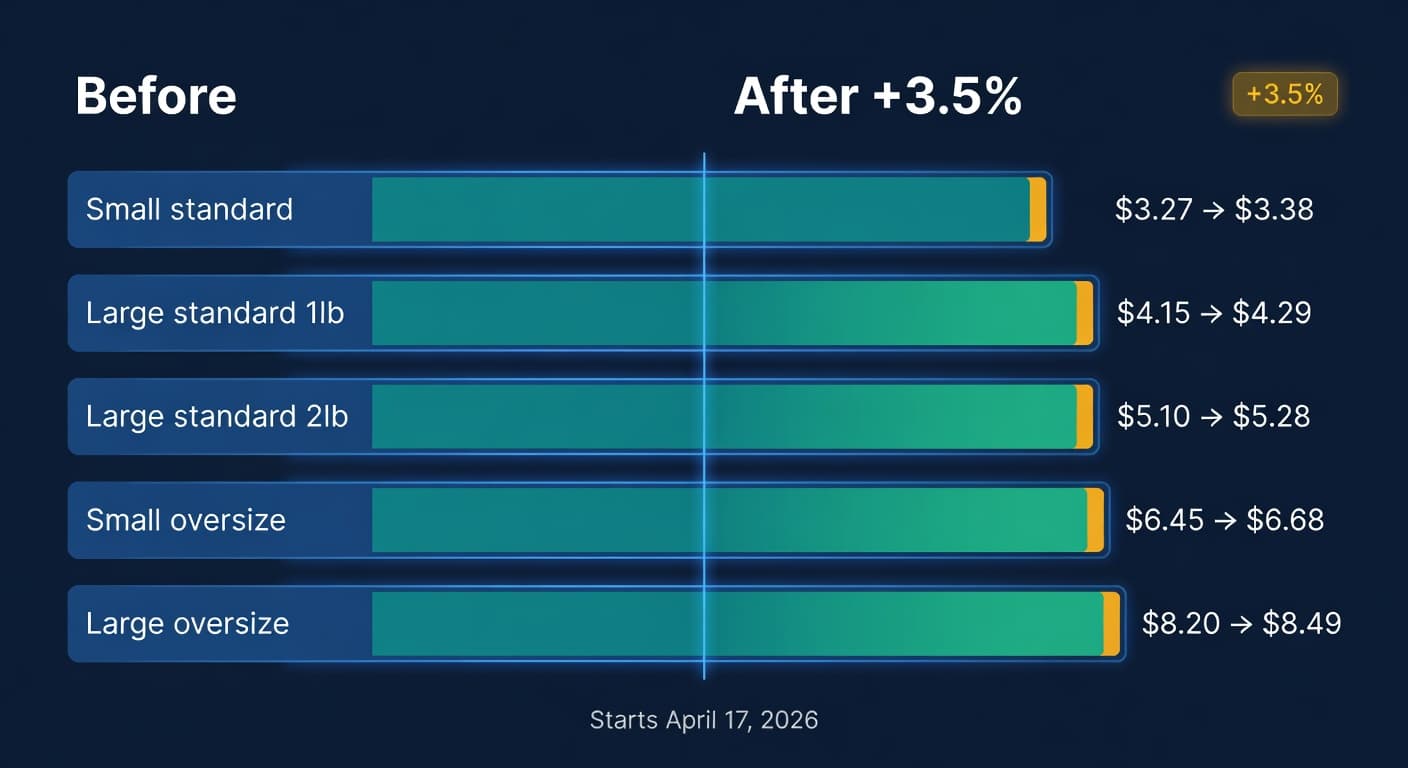
I took the 2026 fee schedule that went into effect in January and applied the 3.5% surcharge. Here is the before-and-after at each major size tier:
| Size Tier | Base Fee (2026) | Surcharge (+3.5%) | New Total | Annual Cost at 10K Units |
|---|---|---|---|---|
| Small standard (6 oz) | $3.27 | +$0.11 | $3.38 | +$1,100 |
| Large standard (1 lb) | $4.82 | +$0.17 | $4.99 | +$1,700 |
| Large standard (2 lb) | $5.50 | +$0.19 | $5.69 | +$1,900 |
| Small oversize | $9.84 | +$0.34 | $10.18 | +$3,400 |
| Large oversize | $15.83 | +$0.55 | $16.38 | +$5,500 |
Seventeen cents does not sound like much until you do the volume math. A seller moving 10,000 large standard units per month just picked up $1,700 in annual costs that did not exist last week.
And this is on top of the fulfillment fee increases that already hit in January. A large standard item at 1 lb went from $4.75 in 2025 to $4.82 in January to $4.99 now. That is a 5% increase in four months.
A Worked Example
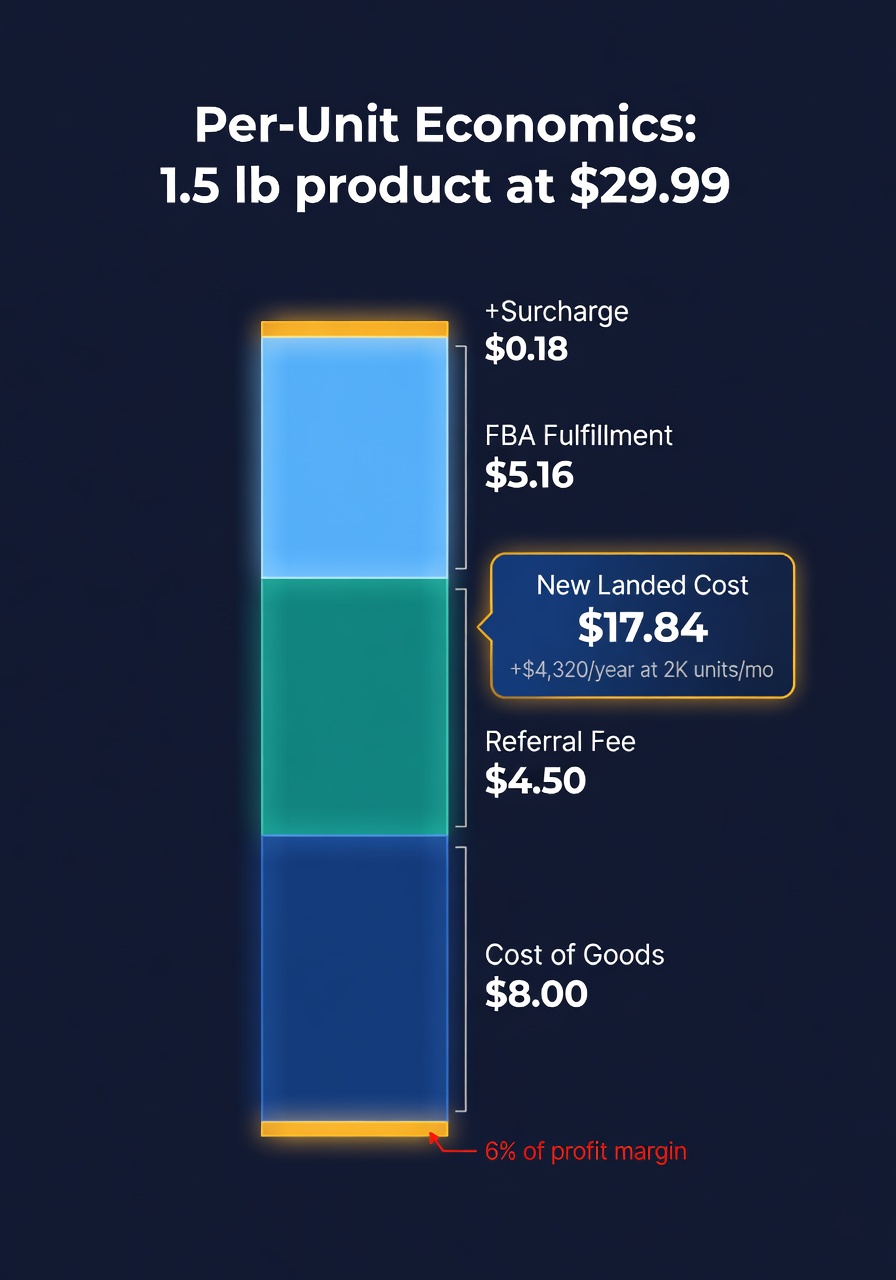
Say you sell a 1.5 lb product at $29.99. Your fulfillment fee before this surcharge was roughly $5.16 (between the 1 lb and 2 lb brackets). Your 15% referral fee is $4.50. Your cost of goods is $8.00. Your landed cost per unit was about $17.66.
Now add the surcharge. $5.16 times 1.035 is $5.34. That is $0.18 more per unit. Your new landed cost is $17.84.
Seems trivial. But.
If you sell 2,000 units per month, that is $360/month or $4,320/year. Enough to hire a VA for a quarter. And this stacks with every other fee increase Amazon has rolled out since 2020, when FBA fees were roughly 45% lower than they are now.
The sellers who get hurt worst are the ones with low margins and high volume. If your net margin per unit is $3.00 and this surcharge eats $0.18 of it, that is 6% of your profit gone.
How This Changes Your Reorder Math
This is the part most sellers skip, and it is the part that actually matters.
Higher fulfillment costs change two things in your inventory calculations:
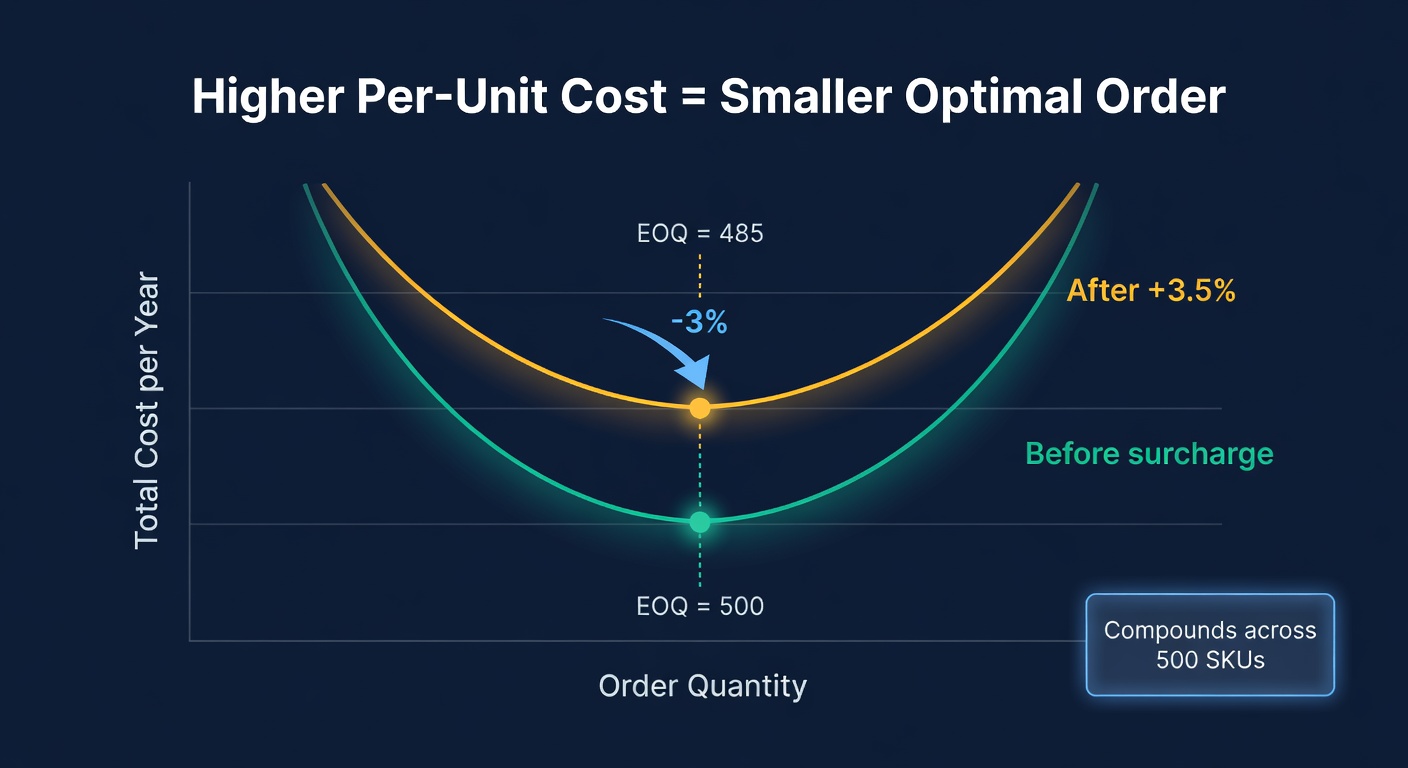
Your landed cost per unit goes up. Landed cost is the denominator in your EOQ formula. When your per-unit cost rises, the optimal order quantity changes. Most sellers never update this number after their initial setup. If your EOQ spreadsheet still has last year's fulfillment fees in it, your order quantities are wrong.
Your holding cost per unit goes up. Holding cost is typically estimated as a percentage of your per-unit cost. Higher per-unit cost means higher holding cost, which means your safety stock and reorder point calculations shift. Not by a lot. But for sellers running tight on cash flow, "not by a lot" still matters.
I ran the numbers on a 500-SKU catalog with average fulfillment fees around $5.00. The surcharge adds $0.175 per unit across the catalog. At 50,000 total units per month, that is $8,750/month or $105,000/year. The EOQ adjustment alone changes optimal order sizes by 2-4% for most SKUs. Not dramatic, but it compounds across a full catalog.
Three Things to Do Now That It Is in Force
1. Update your landed cost inputs. Whatever tool or spreadsheet you use for reorder calculations, the fulfillment fee input needs to reflect the 3.5% surcharge. If you do not update it, your margin calculations will be optimistic by $0.11 to $0.55 per unit depending on size tier. That error flows into every downstream decision.
2. Re-evaluate your FBA vs. FBM split. If you have SKUs where the margin was already thin on FBA, this surcharge might push them into FBM territory. Run the math on your bottom 20% by margin. Some of those SKUs are now losing money on FBA fulfillment. Moving them to FBM or a 3PL might be the right call.
3. Check your aged inventory exposure. Higher fulfillment costs make slow-moving inventory even more expensive. A unit sitting in FBA for 6+ months is now costing you more to fulfill when it eventually sells AND more in aged inventory surcharges while it sits there. If you have been putting off a dead stock cleanup, this is a good reason to stop putting it off.
Stop Recalculating Manually
Every time Amazon changes fees - and they change them constantly - the manual version of this process is the same. You download the new fee schedule. You update your spreadsheet. You recalculate landed costs. You adjust reorder points. You hope you did not miss a size tier or fat-finger a cell.
ReplenishRadar factors fulfillment costs into reorder recommendations. When the cost inputs change, the math updates across your entire catalog. Your reorder points, safety stock levels, and EOQ suggestions reflect the actual per-unit economics, not whatever you remembered to type into a spreadsheet three months ago.
Try ReplenishRadar free for 14 days ->
The Pattern
This is the third time in four years Amazon has added a surcharge that they described as temporary. FBA fees have increased 45% since 2020. The surcharges either become permanent or get folded into the next year's base rate increase. Build your financial models assuming this 3.5% is permanent, and be pleasantly surprised if it is not.
The sellers who survive fee creep are the ones who update their numbers the week the change is announced, not the week after they notice their margins shrank.
Related Reading:
Frequently Asked Questions
Get notified when it matters
Amazon and Shopify change the rules constantly. We'll email you when something affects your business.
See what your inventory is really doing
Doing $5M+ in revenue? Talk to our team
Related Posts
How to Handle Oversold Orders in E-commerce
Why overselling happens on multi-channel stores, what it costs you, and the prevention strategies that actually work, from buffer stock to real-time push sync.
Amazon Lost Inventory: How to Get Reimbursed
How to find lost or damaged FBA inventory, file reimbursement claims with Amazon, and stop leaving 1-3% of your FBA revenue on the table.
Amazon Low-Inventory-Level Fee Explained
How Amazon's low-inventory-level fee works, which products are exempt, fee amounts by days of supply, and how to avoid it without triggering storage fees.
