Amazon GWD: Fee Math, Pipeline Risk, and Who It Fits

Amazon launched Global Warehousing and Distribution last week. Store your inventory in Shenzhen at $8.79 per cubic meter. Let Amazon ship it to US fulfillment centers when you need it. The pitch sounds good.
I spent the past few days reading through every page of the Seller Central documentation. The storage savings are real. But there are constraints buried in the details that will catch sellers off guard if they do not read the fine print before shipping their first container.
Here is what the fee math actually looks like, where the pipeline risk sits, and who should (and should not) be looking at this program.
The Fee Comparison
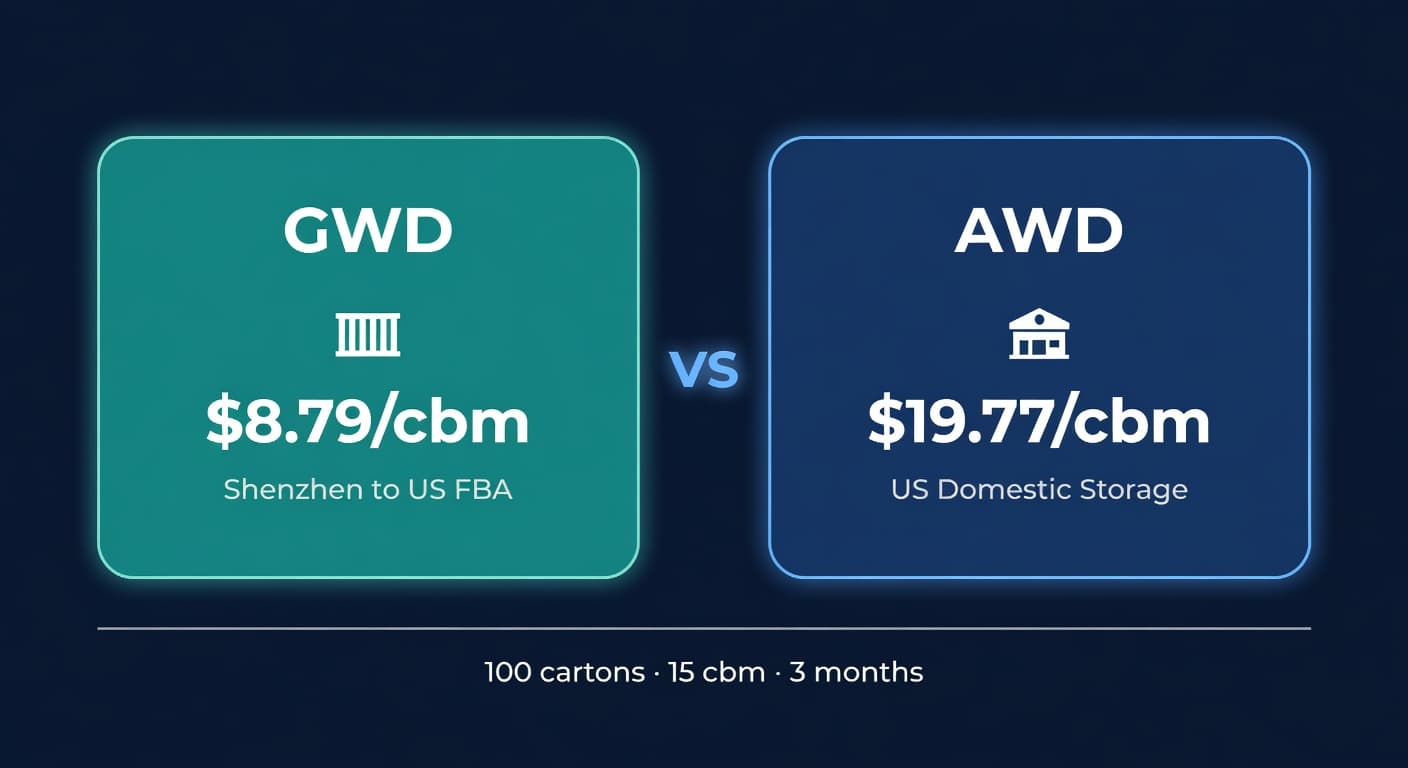
GWD storage costs $8.79 per cubic meter per month. US AWD runs about $19.77/cbm. That is a 55% discount on the storage line item alone.
But storage is not the only cost. GWD charges processing and export declaration fees that do not exist in domestic AWD. And you still pay AGL for ocean freight from Shenzhen to the US.
Here is a worked example. Say you ship 100 cartons totaling 15 cubic meters and store them at GWD for 3 months before distributing to FBA.
| Fee | Calculation | Amount |
|---|---|---|
| Storage (3 months) | 15 cbm x $8.79 x 3 | $395.55 |
| Inbound processing | 100 cartons x $0.20 | $20.00 |
| Outbound processing | 100 cartons x $0.30 | $30.00 |
| Export declaration (inbound) | 1 shipment x $50 | $50.00 |
| Export declaration (outbound) | 100 cartons x $0.10 | $10.00 |
| GWD total | $505.55 |
The same 15 cbm stored for 3 months at US AWD:
| Fee | Calculation | Amount |
|---|---|---|
| Storage (3 months) | 15 cbm x $19.77 x 3 | $889.65 |
| US AWD total | $889.65 |
That is $384.10 in savings on the storage and handling side. Real money. But it is not the full picture.
You still need to get the goods from Shenzhen to the US. AGL handles that leg, and their ocean freight rates are separate from GWD fees. Amazon does not publish a fixed AGL rate card publicly. The rate depends on your volume, container type, and lane. For a rough benchmark, standard ocean freight from South China to the US West Coast has been running $3,000 to $5,000 per 40-foot container through early 2026.
If your goods were already shipping from China to the US via AGL or another forwarder, GWD does not add that cost. It just moves the storage location from a US warehouse to the origin. The savings are the storage delta.
If your goods were already sitting in a US 3PL or AWD facility and you are considering moving your supply chain to GWD, you need to factor in the AGL leg as a new cost.
The Pipeline Problem
This is the part that worries me most.
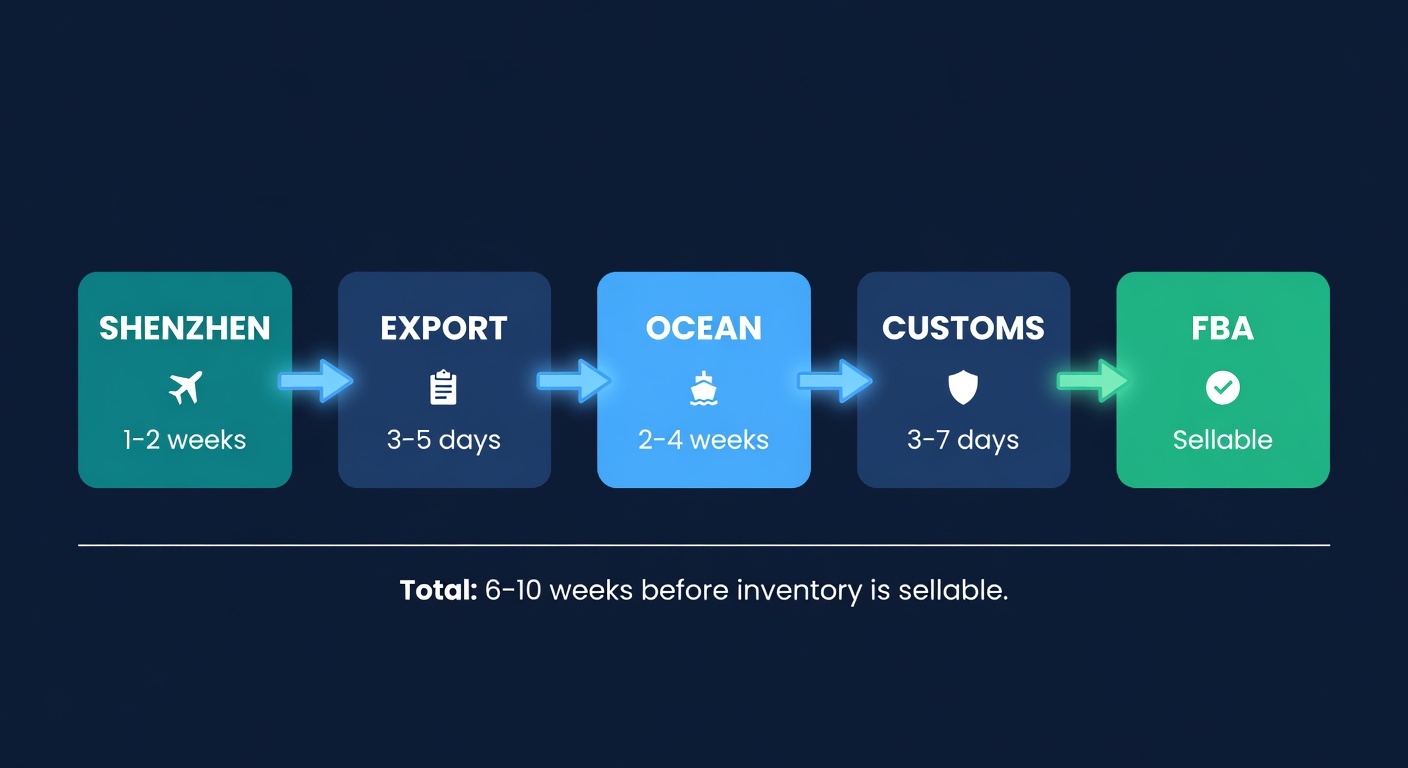
Inventory sitting at GWD in Shenzhen is not sellable. It does not count toward your FBA inventory. It cannot fill customer orders. It has to physically travel by ocean freight to a US fulfillment center, clear customs, get received, and hit a Prime-eligible bin before it generates a single sale.
Amazon says to expect "standard ocean transit times" for the GWD-to-FBA leg. That is vague on purpose. Standard ocean from South China to the US West Coast runs 14 to 21 days in normal conditions. Add port congestion, customs clearance, and FBA receiving time, and you are looking at 3 to 6 weeks from the moment you trigger a replenishment to the moment those units are available for sale.
If you manage your FBA inventory on tight weeks-of-cover targets, that transit window changes everything. You need to carry more FBA safety stock to cover the replenishment lead time from Shenzhen. Running lean at FBA while your buffer sits on the other side of the Pacific is a recipe for stockouts.
I have been tracking FBA receiving times for a while now, and the variance is significant. Some fulfillment centers process inbound in 3 days. Others take 14. When you add ocean transit variance on top of receiving variance, the total pipeline window could swing from 17 days to 49 days.
That swing is what kills your safety stock calculation. If you set your safety stock based on the average pipeline time, you will stock out half the time. If you set it based on the worst case, you will overstock.
The Traps
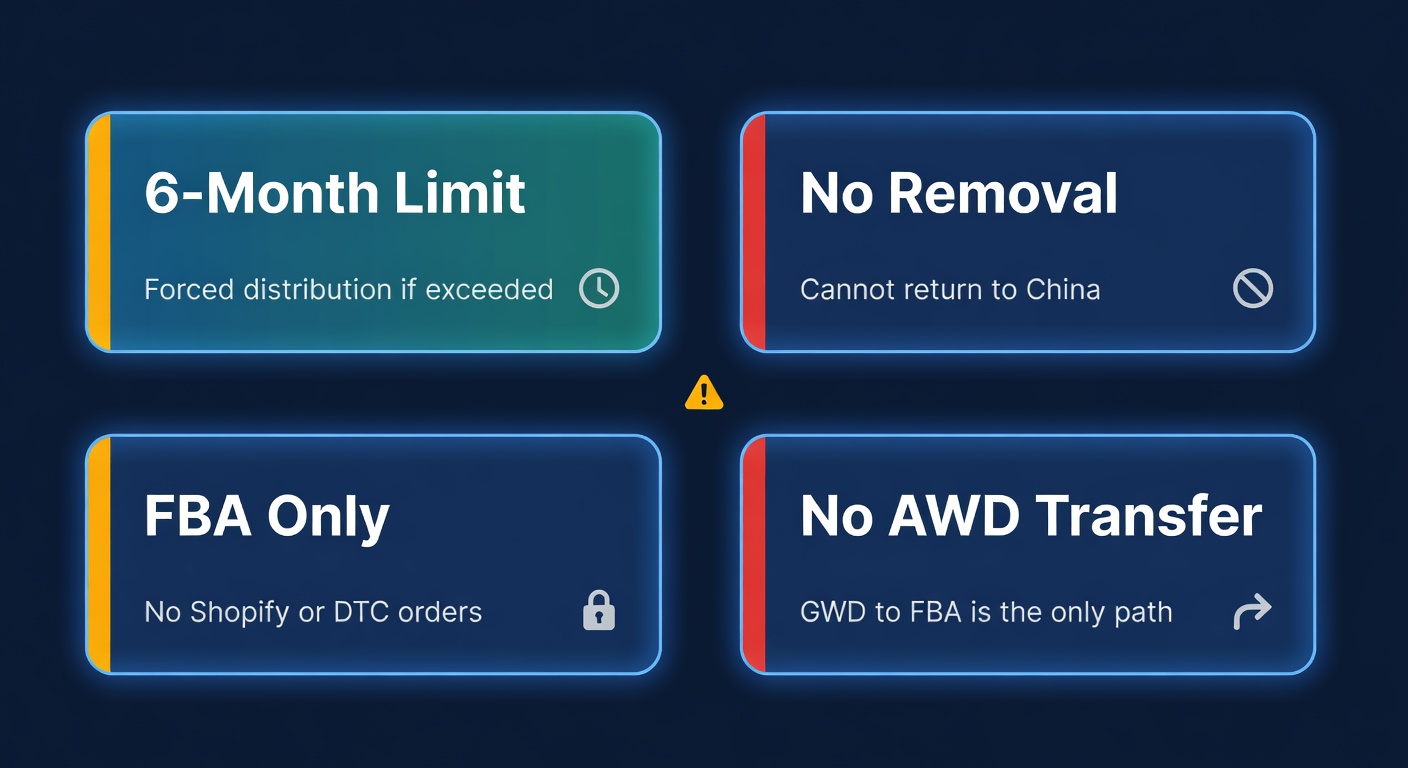
I counted four constraints in the documentation that most sellers will not notice until they matter.
The 6-month storage limit. GWD's Shenzhen facility has a 6-month maximum storage duration. You can request a 6-month extension, but there is a process and it is not guaranteed. If you hit the limit, Amazon requires you to distribute the inventory to FBA. You do not get to leave it sitting there while you figure out your plan.
For slow-moving SKUs, this is a problem. If you ship 500 units of a product that sells 2 per day, you have 250 days of supply. That exceeds the 6-month window. You will be forced to push units to FBA before you need them, which means paying US storage fees on inventory you did not plan to restock yet. The storage savings evaporate.
No removal back to China. The Shenzhen facility operates as a bonded or exports supervised warehouse. Once your inventory clears export declaration, there is no sending it back. The only exit is forward to a US fulfillment center. If your listing gets suspended, if a product gets recalled, if demand craters and you want to pull inventory out of the pipeline, you cannot. Those units are going to FBA whether you want them there or not.
No multi-channel distribution. GWD inventory can only go to Amazon's US fulfillment network. Period. If you sell on Shopify, on your own site, through a 3PL, or anywhere outside Amazon, GWD cannot serve those channels. This is FBA-only inventory.
For sellers running both Amazon and DTC, this means maintaining two supply chains. Your Shopify inventory still needs to come through your existing pipeline. GWD only covers the Amazon side.
No GWD-to-AWD transfers. You might think you could store cheap at GWD and then move to US AWD for domestic distribution flexibility. Amazon explicitly says this is not supported. GWD to FBA is the only path.
Auto-Replenishment: The Setting That Matters Most
Amazon offers two replenishment modes for GWD inventory.
The first is fully automated. Amazon's system decides when and how much to ship from GWD to FBA based on their demand model. You trust the algorithm.
The second is manual with configurable limits. You set minimum and maximum unit thresholds for FBA inventory per SKU. Amazon creates replenishments when your FBA stock hits the minimum, up to your maximum. You control the bounds. Amazon handles the execution.
Getting those min/max limits right is the entire game. Set the minimum too low and you stock out while waiting 3 to 6 weeks for ocean freight. Set it too high and you are paying US storage fees on excess inventory that could have sat cheaper in Shenzhen.
The right limits depend on your daily sales velocity, the pipeline lead time (which you will not know precisely until sellers start generating real data), and how much demand variability you see. This is a demand forecasting problem at its core. A good forecast with accurate lead time data produces tight min/max limits. A bad forecast produces either stockouts or overstock. There is no middle ground.
I am watching the early data closely as sellers start using GWD. Pipeline times from Shenzhen to specific US fulfillment centers will be the most important variable, and nobody has real numbers yet.
Who GWD Actually Fits
Not every seller should rush to sign up. This program has a specific profile where it makes sense.
Good fit:
- You source from China (ideally near Shenzhen or Guangdong)
- You sell exclusively on Amazon US
- Your products have stable, predictable demand
- You already use or plan to use AGL for ocean freight
- You move enough volume that the per-shipment export declaration fees ($50 inbound) are negligible per unit
- Your SKUs turn fast enough to stay within the 6-month storage limit
Bad fit:
- You sell on Shopify, your own site, or any channel besides Amazon. GWD cannot serve those orders.
- You have seasonal products with demand spikes. The 3-to-6 week pipeline means you cannot react quickly.
- You source from outside China. GWD is Shenzhen only right now.
- You need removal flexibility. Product recalls, listing suspensions, or demand drops become much harder to manage when inventory can only move forward.
- You carry slow-moving SKUs that would exceed the 6-month storage limit.
If you are on the fence, start small. Send one or two fast-moving SKUs to GWD and track the actual pipeline times. Do not move your entire catalog on day one.
The Landed Cost Angle
Sellers who already calculate true landed cost know that storage is only one component. GWD changes where you pay some costs but does not eliminate them.
Here is what shifts with GWD:
| Cost Component | Without GWD | With GWD |
|---|---|---|
| Factory to port/warehouse | Domestic China shipping | Domestic China shipping (shorter, Shenzhen) |
| Storage | US 3PL or AWD ($19.77/cbm) | GWD Shenzhen ($8.79/cbm) |
| Cross-border freight | AGL or forwarder (you pay this either way) | AGL (same) |
| Customs/export fees | Standard import duties | Standard import duties + GWD export declaration fees |
| FBA inbound | Standard FBA receiving | Standard FBA receiving |
| FBA storage | Standard FBA rates | Standard FBA rates (for units at FC) |
The net effect: you save on the storage line while adding GWD processing and export fees. For a 15 cbm shipment stored 3 months, the savings are roughly $384. For larger volumes or longer storage durations, the savings scale proportionally.
But if you shift from a model where your US warehouse held buffer stock and could ship to FBA in 2 to 3 days, to a model where your buffer sits in Shenzhen with a 3-to-6 week pipeline, you may need to carry more FBA inventory to cover the longer lead time. That extra FBA inventory incurs US storage costs that partially offset the GWD savings.
We built ReplenishRadar to track these pipeline variables across suppliers and fulfillment paths. As sellers start using GWD, we will be publishing what we learn about actual transit times and intake windows from Shenzhen to specific US fulfillment centers.
What I Am Watching
GWD is brand new. The documentation is thorough, but real-world data does not exist yet. Three things will determine whether this program is a minor convenience or a significant supply chain shift for Amazon sellers:
Actual pipeline times. Amazon's "standard ocean transit" estimate is a range, not a number. Once sellers start shipping, we will know whether GWD-to-FBA consistently takes 3 weeks or 6 weeks. That variance determines how much safety stock you need at FBA.
Auto-replenishment reliability. Amazon's algorithm will manage replenishment triggers for sellers who opt in. How well it matches actual demand patterns will make or break the hands-off appeal.
Fee evolution. GWD launched at $8.79/cbm. Amazon has a history of adjusting fees after programs gain adoption. The FBA fee increases over the past two years are a reminder that launch pricing is not forever pricing.
Run the numbers for your specific catalog. Check whether the 6-month limit and the no-removal constraint work for your product lifecycle. And do not commit your entire inventory until you have real pipeline time data.
The savings are real. The constraints are real too. Know both before you ship.
Try ReplenishRadar free for 14 days ->
Related Reading:
- How to Calculate True Landed Cost for E-commerce
- FBA Receiving Times by Fulfillment Center
- Safety Stock Calculation Guide
- Tariffs and Inventory Strategy in 2026
- Amazon FBA vs FBM: Inventory Planning Differences
Frequently Asked Questions
Get notified when it matters
Amazon and Shopify change the rules constantly. We'll email you when something affects your business.
See what your inventory is really doing
Doing $5M+ in revenue? Talk to our team
Related Posts
Amazon FBA vs FBM: Inventory Planning Guide
FBA vs FBM vs Seller Fulfilled Prime cost comparison with inventory planning differences. When each option wins and how to run hybrid.
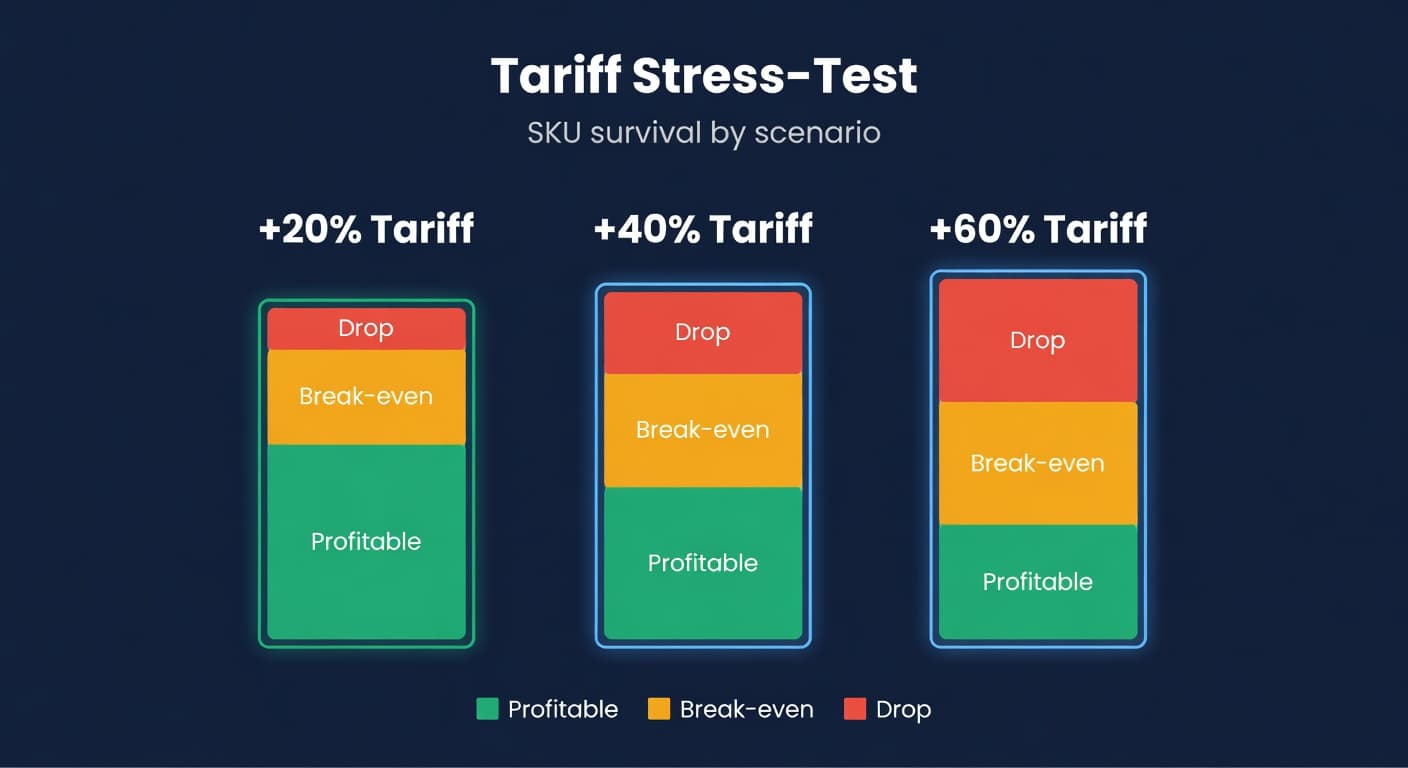
How to Tariff Stress-Test Your FBA Catalog
A SKU-level tariff stress-test workflow for FBA sellers. Apply +20%, +40%, +60% scenarios, find break-even prices, and decide what to keep.
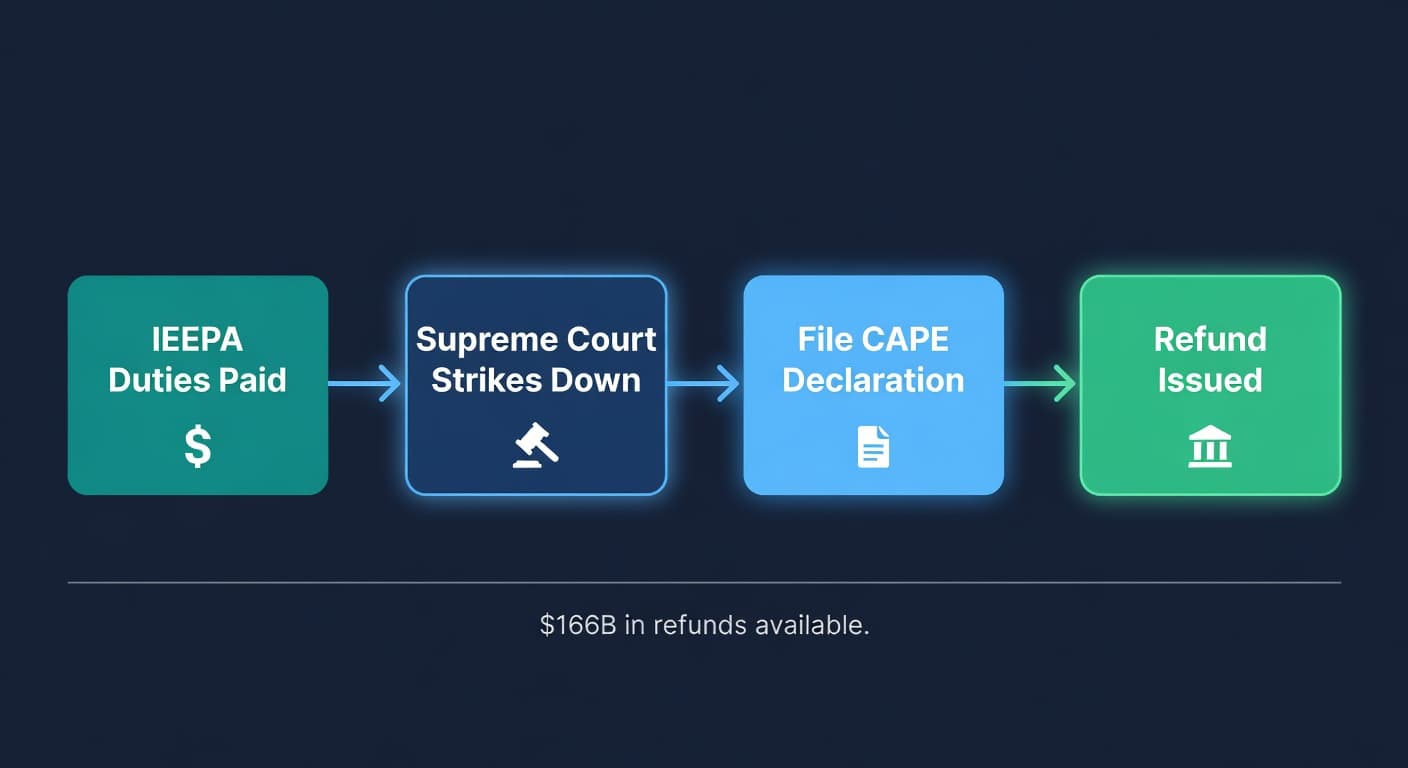
IEEPA Tariff Refund Portal: FBA Seller Guide
CBP's CAPE portal is live. If you paid IEEPA tariffs on imports, here's how to check eligibility and file for a refund before the window closes.
