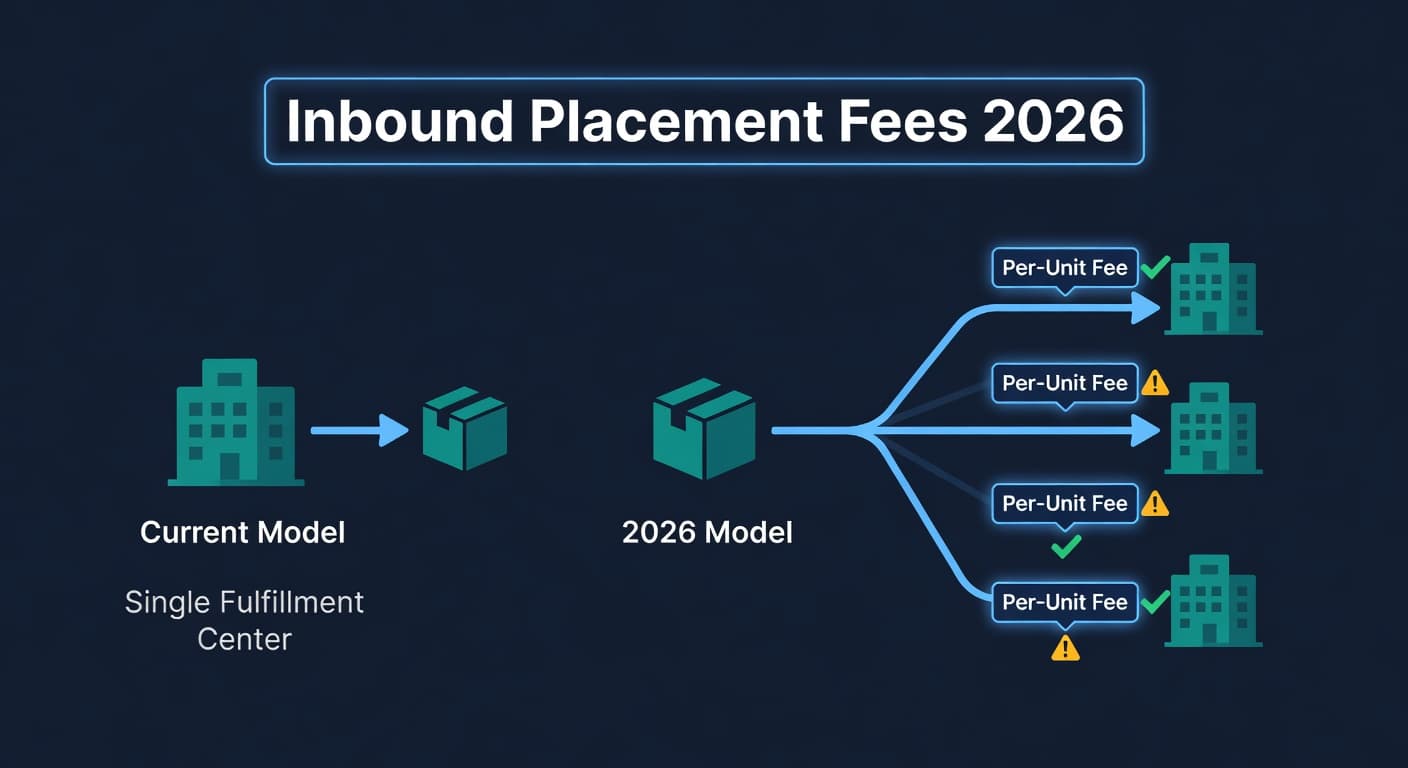
Amazon Inbound Placement Fee Changes for 2026
Amazon Wants You to Split Shipments. And They Will Charge You If You Don't.
Amazon rolled out updated inbound placement service fees effective January 2026. The structure is the same as 2024-2025 - you pay per unit if you send to fewer FCs than Amazon wants - but the rates are higher.
This fee still confuses sellers. I get questions about it constantly. So here is the plain version: Amazon operates a distributed network of fulfillment centers. They want your inventory spread across multiple FCs so they can ship to customers faster. If you send everything to one warehouse and make Amazon move it, you pay for that redistribution. That is the placement fee.
The Updated Rate Card
Rates depend on your item size, weight, and which shipping option you choose in the Send to Amazon workflow.
| Size Tier | Minimal Shipment Splits (2025) | Minimal Splits (2026) | Increase |
|---|---|---|---|
| Small standard | $0.23 | $0.25 | +$0.02 |
| Large standard (1 lb) | $0.40 | $0.44 | +$0.04 |
| Large standard (2 lb) | $0.53 | $0.59 | +$0.06 |
| Small oversize | $0.68 | $0.75 | +$0.07 |
| Large oversize | $1.15 | $1.26 | +$0.11 |
Those are the rates for "minimal shipment splits" - the option where you send to the fewest possible FCs. If you choose Amazon-optimized splits (shipping to 3-5 FCs), the placement fee drops to zero. You still pay carrier shipping, but the fee itself disappears.
The Math Most Sellers Get Wrong
Sellers look at the placement fee and think "I'll just send to one FC to keep things simple." That instinct is expensive.
Let me walk through a real example. Say you are shipping 2,000 units of a 1 lb standard-size product.
Option A: Minimal splits (one FC)
- Placement fee: 2,000 x $0.44 = $880
- Carrier shipping: ~$320 (one pallet, one destination)
- Total: $1,200
Option B: Amazon-optimized splits (four FCs)
- Placement fee: $0
- Carrier shipping: ~$680 (four smaller shipments)
- Total: $680
Option B saves $520 on a single shipment. Over a year of monthly restocks, that is $6,240. The split shipments take more prep time - you are packing four shipments instead of one - but for most sellers the savings justify the extra 30-60 minutes.
The exception: very small shipments. If you are sending fewer than 100 units, the per-shipment carrier minimums can make splits more expensive than just paying the placement fee. Run the numbers both ways every time.
What Changed Beyond the Rates
Two smaller changes worth knowing:
Non-partnered carrier rates went up. Amazon narrowed the gap between their partnered carrier rates and what you pay using your own freight forwarder. In 2025, sellers using their own carriers on the Amazon-optimized splits option could undercut Amazon's rates by 15-20%. That gap is now more like 8-12%.
Partial shipment splits got a new tier. Amazon added an intermediate option for some product categories where you can ship to 2 FCs instead of 1 or 4+. The placement fee on this middle option is roughly half the minimal-splits rate. It is not available for all products, but check the Send to Amazon workflow - if you see three options instead of two, the middle one might be your sweet spot.
What to Do Right Now
First, stop defaulting to minimal splits. I know it is easier. It is also the most expensive option, and the gap just widened.
Second, if you are doing the split shipments yourself, time how long prep takes. For most sellers, the incremental labor for 4 shipments vs 1 is 30-45 minutes. If your placement fee savings exceed $200 per shipment, the hourly return on that labor is exceptional.
Third, recalculate your landed cost per unit. Inbound fees are part of your cost basis, and if you haven't updated your numbers since 2024, your margin calculations are stale.
How ReplenishRadar Handles Inbound Planning
When ReplenishRadar generates a transfer suggestion for FBA, it factors in lead time through the full inbound pipeline - from your warehouse to when inventory becomes available for sale, including reorder point timing. That includes receiving time, which varies by fulfillment center and time of year. We don't tell you which split option to pick (that depends on your carrier contracts), but we do tell you when to ship so your inventory lands before you stock out.
Try ReplenishRadar free for 14 days
Related Reading:
- Amazon FBA Restock Strategies
- How to Calculate True Landed Cost
- FBA Receiving Times by Fulfillment Center
- Streamline FBA Inbound Shipments
Frequently Asked Questions
Get notified when it matters
Amazon and Shopify change the rules constantly. We'll email you when something affects your business.
See what your inventory is really doing
Doing $5M+ in revenue? Talk to our team
Related Posts
Prime Day Inventory Prep Checklist for FBA Sellers
A week-by-week Prime Day inventory checklist covering FBA send-in deadlines, demand forecasting, storage fees, and the mistakes that cost sellers thousands.
How to Handle Oversold Orders in E-commerce
Why overselling happens on multi-channel stores, what it costs you, and the prevention strategies that actually work, from buffer stock to real-time push sync.
Amazon Lost Inventory: How to Get Reimbursed
How to find lost or damaged FBA inventory, file reimbursement claims with Amazon, and stop leaving 1-3% of your FBA revenue on the table.
