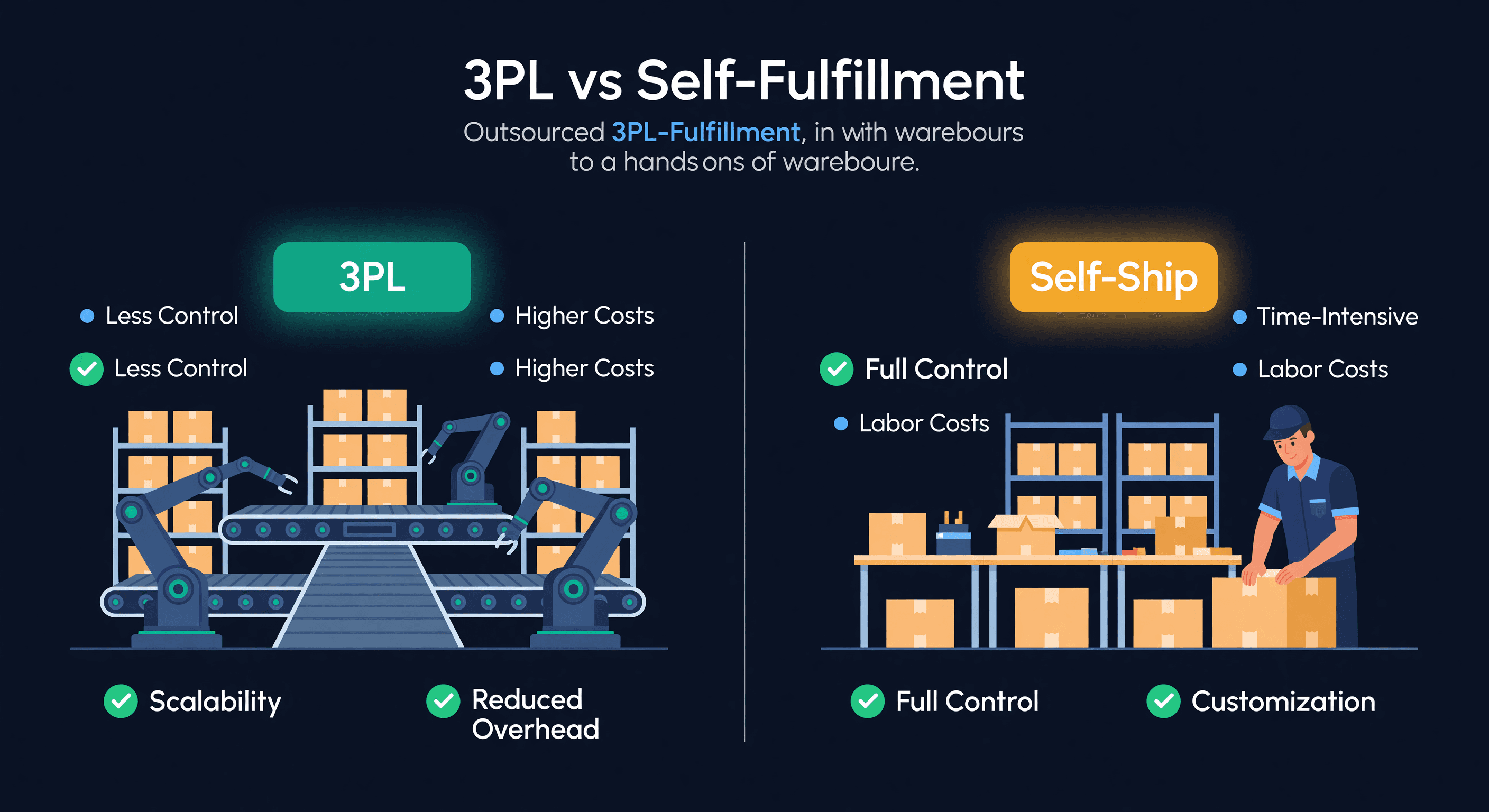
3PL vs Self-Fulfillment for E-commerce
Key takeaway: Switch to a 3PL when you consistently ship 200+ orders per day or need multi-warehouse geographic coverage. Below 50 orders per day, self-fulfillment is almost always cheaper. Between 50-200, run the per-order unit economics to decide.
I Packed 847 Orders in a Weekend Once. That Was the Last Weekend I Did It.
My second Black Friday as an e-commerce seller, I did $38,000 in sales over four days. Sounds great. What the revenue number does not tell you is that I spent 14 hours on Saturday and 12 hours on Sunday standing at a folding table in my garage, printing labels, taping boxes, and driving loads to the UPS drop-off in my minivan. My spouse was not impressed.
That Monday, I started researching 3PLs. Six months later I moved half my fulfillment to one. But I kept the other half in-house, and that split turned out to be the right call - for reasons I did not expect.
The Real Cost of Self-Fulfillment
Most sellers who pack their own orders think their fulfillment cost is just the shipping label. It is not. Not even close.
Here is what self-fulfillment actually costs, broken down for a seller shipping 100 orders per day:
| Cost Category | Monthly Cost | Per-Order Cost |
|---|---|---|
| Warehouse rent (1,500 sq ft) | $2,250 | $0.75 |
| One full-time packer ($18/hr) | $3,120 | $1.04 |
| Packing materials | $450 | $0.15 |
| Shipping labels (average) | $5.50/order | $5.50 |
| Insurance + liability | $250 | $0.08 |
| Equipment (amortized) | $150 | $0.05 |
| Your time (10 hrs/week managing) | $1,000 | $0.33 |
| Total | $12,720 | $7.90 |
That "$5.50 per order" everyone quotes is actually $7.90 when you count everything. And I am being generous with the warehouse rent - $1.50/sq ft is cheap in most metros.
The line that gets ignored: your time. Ten hours a week managing packing stations, fixing shipping errors, handling carrier pickups, dealing with warehouse problems. At any reasonable value of your time, that is $25-$50/hour you are not spending on product development, marketing, or supplier negotiations. That is the real cost.
The Real Cost of a 3PL
3PL pricing is deliberately confusing. They break fees into a dozen line items so you cannot easily compare to your all-in self-fulfillment cost. Here is what the same 100 orders/day actually costs at a mid-tier 3PL:
| Fee Type | Rate | Monthly Cost (100 orders/day) |
|---|---|---|
| Pick and pack | $3.50/order | $10,500 |
| Storage (20 pallets) | $25/pallet/month | $500 |
| Receiving | $35/pallet | $175 (5 pallets/month) |
| Shipping (discounted) | $4.80/order | $14,400 |
| Returns processing | $3.50/return (10% rate) | $1,050 |
| Account management fee | $250/month | $250 |
| Total | $26,875 | |
| Per order | $8.96 |
At 100 orders per day, the 3PL costs $8.96 versus self-fulfillment at $7.90. The 3PL is $1.06 more per order. Across 3,000 monthly orders, that is $3,180 per month.
But here is what the pure cost comparison misses.
What the Spreadsheet Does Not Capture
The $3,180/month premium buys you three things no spreadsheet can quantify properly.
Your weekends back. That $1,000/month I charged for "your time" at 10 hours per week? That was conservative. During peak season, it is 20-30 hours. If you are the founder, every hour spent packing boxes is an hour not spent growing the business. I know this sounds like consultant-speak, but I lived it. The six months after I moved to a 3PL, revenue grew 40%. Coincidence? Maybe. But I had 15 extra hours per week to work on marketing and product launches.
Geographic coverage. Shipping from one garage in Ohio means 4-5 day delivery to California. A 3PL with a West Coast facility gets you 2-day ground to 60% of the US population. I watched my conversion rate on DTC orders improve 8% after switching to a 3PL with two warehouses - East Coast and West Coast. Customers care about delivery speed even when they say they do not.
Flex capacity. My garage operation could handle 100 orders/day with one packer. At 150 orders, I needed a second person. At 200, I needed a bigger space. Every growth threshold required a step-function increase in fixed costs. A 3PL absorbs those volume swings. You pay per order, so your cost scales linearly instead of in painful jumps.
When Self-Fulfillment Wins
I am not here to tell you that 3PLs are always the answer. They are not.
Low volume (under 50 orders/day). At 30 orders per day, you can pack everything yourself in 2-3 hours. The 3PL per-order fee structure hurts at low volumes because the fixed account management fees and storage minimums eat into thin margins. I would not consider a 3PL until hitting 50 orders per day consistently, and even then, only if the growth trajectory is clear.
Custom packaging or kitting. If your brand depends on the unboxing experience - hand-written notes, custom tissue paper, specific insert placement - most 3PLs will butcher it. They are built for speed, not presentation. I tried having a 3PL handle my premium product line and the complaints started within a week. "Why does my package look like it came from a warehouse?" Because it did. Custom packaging stays in-house.
Fragile or complex products. Products that need special handling - glass, oversized items, anything that requires assembly or testing before shipment - are expensive at a 3PL. The "special handling" surcharges stack up, and breakage rates climb when someone who does not know your product is packing it.
High-margin, low-SKU count. If you sell 5 products and your margins are 60%+, the cost difference between self-fulfillment and a 3PL barely matters. You are not spending enough time on fulfillment for it to be a bottleneck. Keep it in-house, keep it simple.
The Hybrid Model
This is what I actually recommend for sellers doing 100-500 orders per day. Not full 3PL. Not full self-fulfillment. Both.
My setup after years of testing:
- Amazon orders go through FBA. Amazon's fulfillment is the cheapest option for Amazon orders by a wide margin once you factor in Prime eligibility and Buy Box impact.
- DTC orders go through a 3PL. Two-day shipping, professional packing, no warehouse lease.
- Wholesale and custom orders I fulfill in-house. These are high-value, low-frequency orders where the customer relationship matters.
The split: roughly 45% FBA, 40% 3PL, 15% self-fulfilled. My all-in fulfillment cost dropped 22% compared to when I was doing everything myself, and I got my weekends back.
The catch with hybrid models is inventory visibility. You need to know what is at FBA, what is at the 3PL, and what is in your own warehouse - in real time. Sell the last 10 units from your 3PL while your warehouse has 200 sitting on a shelf, and you have a fulfillment problem disguised as an inventory problem.
The Switching Decision
Here is my framework. Not a matrix. Not a decision tree. Just the question that matters:
Is fulfillment the bottleneck or the business?
If packing orders is what prevents you from doing the things that grow revenue - launching products, running ads, negotiating with suppliers, improving your forecast or recalibrating reorder points - then outsource it. The per-order premium is a rounding error compared to the revenue you are leaving on the table.
If you are at 30 orders/day and fulfillment takes two hours, it is not a bottleneck. Keep it in-house. Invest the 3PL cost difference into inventory.
The break-even math for most sellers flips somewhere around 150-200 orders per day. Below that, self-fulfillment is cheaper in dollars. Above that, the 3PL is cheaper in total cost of ownership once you count your time, space, and staffing.
Tracking Inventory Across Your Warehouse, 3PL, and FBA
The manual version of multi-location inventory tracking is a spreadsheet with three tabs - one for your warehouse, one for the 3PL, one for FBA - updated whenever you remember to check. I tried this for four months. The spreadsheet was wrong by 15-30% within two weeks of any update because it could not keep up with sales and transfers across locations. I would check my 3PL tab, see 200 units, list the product on my site, and then discover the 3PL had actually shipped those units the day before. Oversold.
ReplenishRadar pulls inventory from all three locations - your warehouse, your 3PL, and FBA - on every sync. One view, actual numbers, updated automatically. When we added multi-location tracking, I stopped maintaining that spreadsheet the same week.
Try ReplenishRadar free for 14 days ->
What to Ask Before Signing with a 3PL
If you decide to outsource, vetting the wrong 3PL is worse than staying self-fulfilled. I signed with my first 3PL based on their pricing sheet and a nice-looking warehouse tour. Three months in, they were losing 2% of my inbound shipments, taking 5 days to process receiving, and charging me $75/hour for "special projects" that included fixing their own mistakes.
Questions that would have saved me $8,000 in wasted fees:
| Question | Why It Matters |
|---|---|
| What is your average receiving turnaround? | More than 48 hours means your inventory sits unlisted. |
| What is your error rate on picks? | Above 0.5% is too high. Ask for data, not promises. |
| Do you integrate with my sales channels directly? | Manual inventory updates from a 3PL defeat the purpose. |
| What is the contract term and exit clause? | Month-to-month is ideal. Annual with 90-day exit is acceptable. Anything longer is a red flag. |
| Can I talk to 3 current clients in my product category? | If they say no, walk away. |
| What happens to my inventory if I leave? | Some 3PLs charge "disposal fees" or delay shipment of your own goods. Get this in writing. |
My second 3PL answered every one of those questions with specifics, not generalities. They have handled my DTC fulfillment for two years and the relationship is the best operational decision I have made.
The 200-Order Threshold
Most e-commerce advice treats the 3PL decision as binary: you either outsource fulfillment or you do not. Real businesses are messier than that. The sellers I know who handle fulfillment best use a mix of channels, keep the high-touch work in-house, and outsource the commodity work to specialists.
If you are below 50 orders/day, pack your own boxes. If you are above 200, get a 3PL. If you are in between, run the numbers with the full cost model above - do not just compare shipping labels. And regardless of where you are, track your actual fulfillment cost per order quarterly. The number changes faster than you think, especially during growth.
The one mistake I see over and over: sellers waiting until fulfillment is a crisis before investigating 3PLs. Vetting a 3PL takes 4-6 weeks. Onboarding takes another 2-4. Start the research when you are at 150 orders/day, not 300. By 300, you are packing boxes at midnight and making bad decisions.
Related Reading:
Frequently Asked Questions
Get notified when it matters
Amazon and Shopify change the rules constantly. We'll email you when something affects your business.
See what your inventory is really doing
Doing $5M+ in revenue? Talk to our team
Related Posts
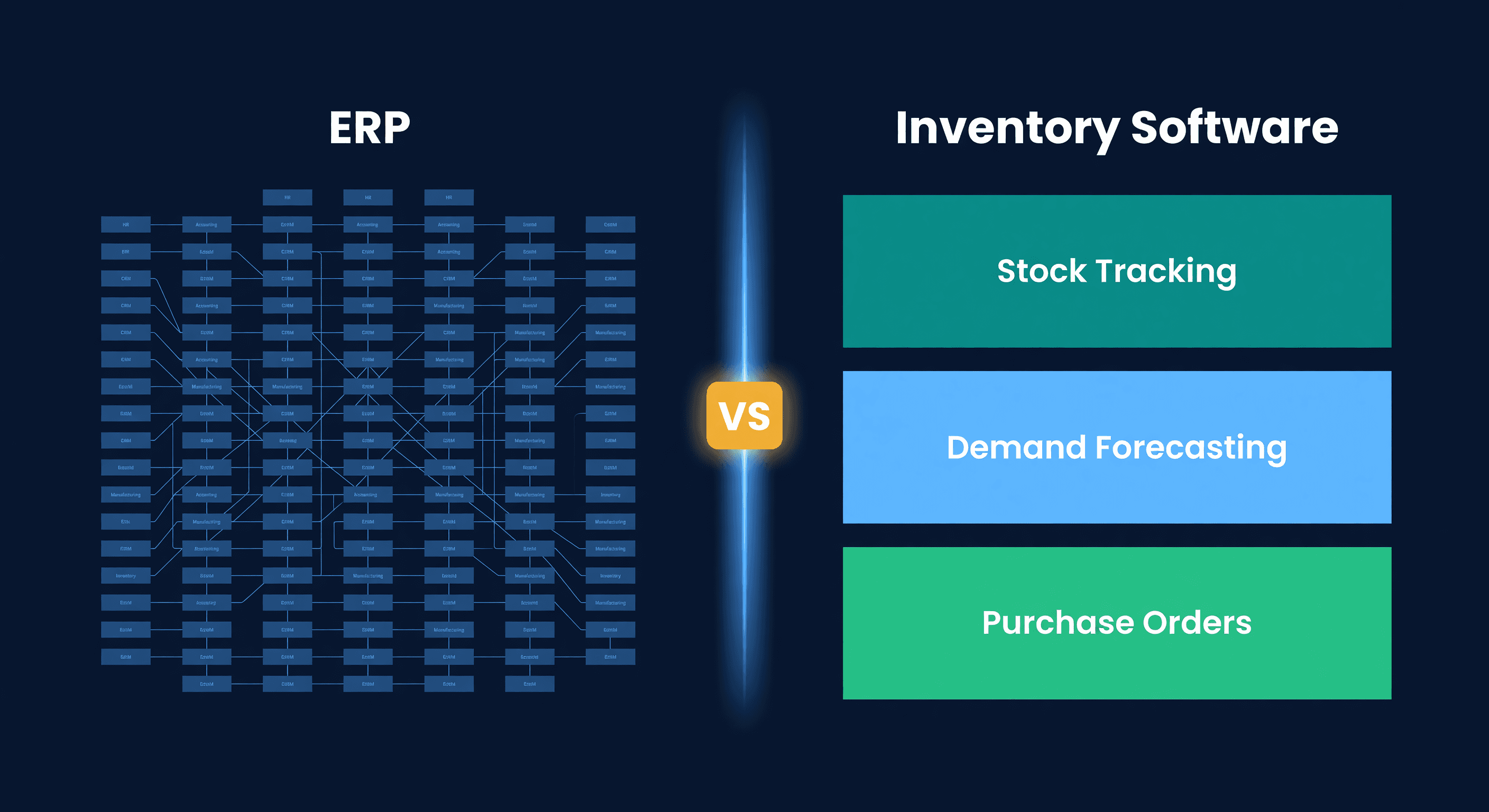
ERP vs Inventory Software: Which Do You Need?
ERPs cost $50K-$200K to implement. Focused inventory tools cost $99-$499/mo. Here's how to know which one is right for your e-commerce business.
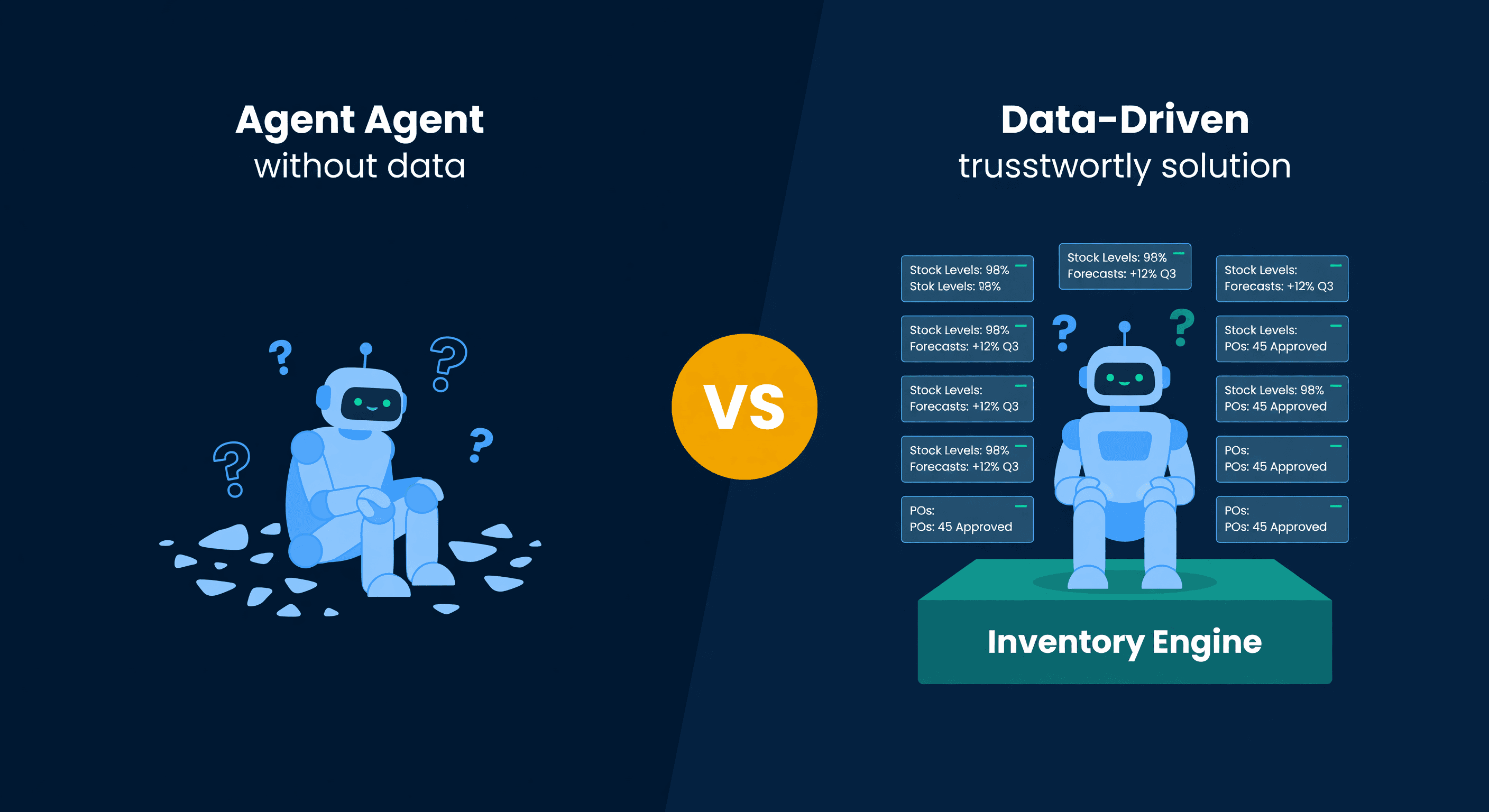
OpenClaw vs Inventory Software: Where AI Agents Fall Short
OpenClaw handles basic Shopify stock alerts but stops short on FBA lead times, multi-channel forecasting, and reorder math. The honest breakdown.
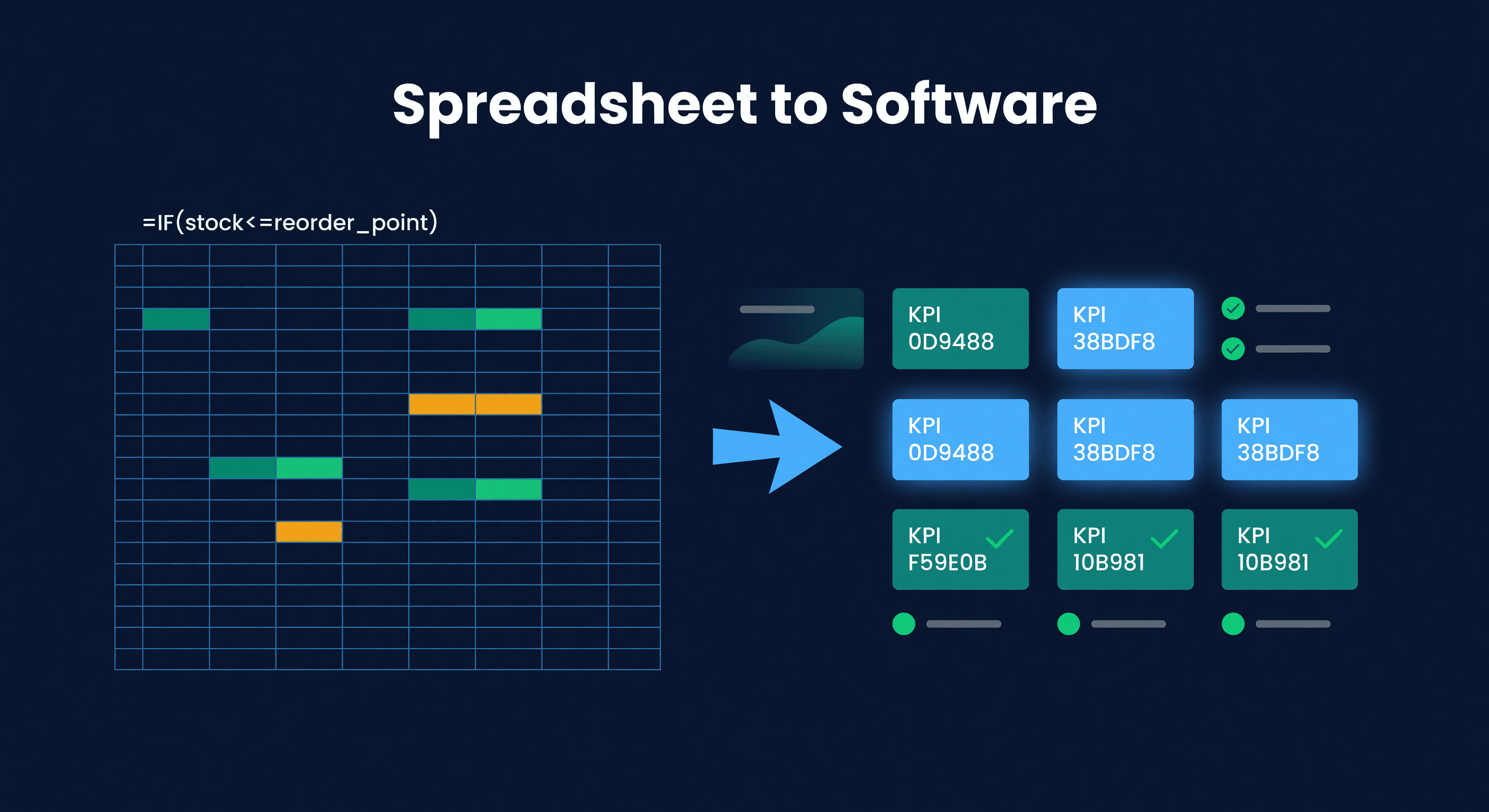
Inventory Spreadsheet Templates (+ When to Quit)
Free Google Sheets inventory templates with formulas. Plus the 5 signs you've outgrown spreadsheets for inventory management.
