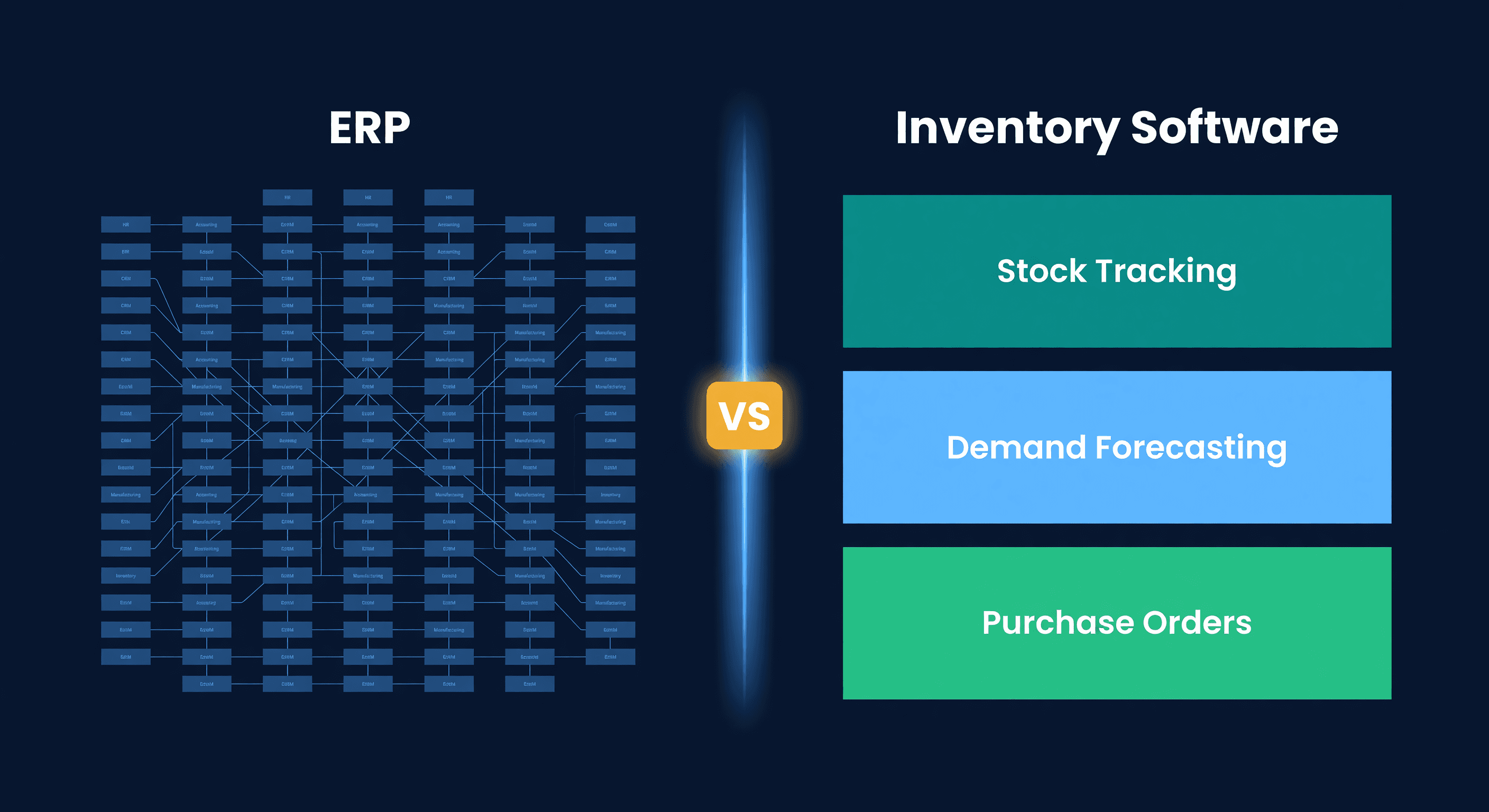
ERP vs Inventory Software: Which Do You Need?

Key takeaway: Most e-commerce resellers under $10M don't need an ERP. ERPs cost $50K-$200K to implement and are built for manufacturers. Focused inventory tools cost $99-$499/mo, connect natively to Shopify and Amazon, and solve the actual problem: knowing what to order and when.
A $150,000 Mistake I Watched Someone Make
A friend of mine runs a $4M e-commerce brand. Shopify storefront, Amazon FBA, about 800 SKUs. All resold products - no manufacturing. In 2024, a consultant told him he needed NetSuite. "You're growing fast. You need to professionalize your operations. Every serious business runs an ERP."
Eight months later he had spent $153,000 on implementation, hired a part-time NetSuite admin, and was still manually exporting CSVs to figure out what to reorder. The ERP was doing his accounting beautifully. It was doing almost nothing for his actual inventory problem.
He did not need an ERP. He needed an inventory management tool that connected to his sales channels.
What an ERP Actually Is
ERP stands for Enterprise Resource Planning. The key word is "enterprise." These systems were built to run entire companies - accounting, human resources, manufacturing, CRM, supply chain, inventory, and more - in a single platform.
The big names: NetSuite (Oracle), SAP Business One, Acumatica, Microsoft Dynamics 365. They are genuine business operating systems. If you run a manufacturing company with 200 employees, multiple legal entities, and a production floor that needs to schedule raw materials into finished goods, an ERP is not optional. It is how the business functions.
But here is what an ERP is not: a specialized inventory tool for e-commerce. ERPs handle inventory as one module among dozens. That module was designed for warehouses and production lines, not for sellers who need to know "how many units should I send to FBA next week?"
What Inventory Management Software Does
Focused inventory tools do one thing well. They connect to your sales channels (Shopify, Amazon, Walmart), pull in real-time stock levels and sales data, forecast demand, and tell you what to order and when.
No GL integration. No HR module. No production planning. Just inventory.
That sounds limiting until you realize that for an e-commerce reseller, inventory is the business problem. You are not scheduling a factory floor. You are trying to avoid stockouts on your top 50 SKUs while not drowning in dead stock on the other 750.
The feature set is narrower but deeper where it matters:
- Native connections to Shopify and Amazon that sync automatically, not through a third-party connector you pay extra for
- Demand forecasting built for e-commerce patterns - flash sales, seasonality, Prime Day spikes - not for stable B2B manufacturing orders
- Purchase order generation that accounts for lead times, safety stock, casepacks, and MOQs
- Multi-channel visibility so you see one stock number per SKU, not a different number in each admin panel
An ERP has an inventory module. Focused inventory software is an inventory module. That distinction matters when your daily problem is "what do I need to order and where do I need to send it."
The Cost Comparison
This is where the decision gets concrete.
| Cost Category | Mid-Market ERP | Focused Inventory Tool |
|---|---|---|
| Implementation | $50,000 - $200,000 | $0 (self-service setup) |
| Monthly license | $500 - $2,000/mo | $99 - $499/mo |
| Time to go live | 3 - 9 months | 1 - 3 days |
| Ongoing admin | Part-time hire or consultant ($1,500-$3,000/mo) | None (managed SaaS) |
| 5-year total cost | $150,000 - $500,000 | $6,000 - $30,000 |
Read that bottom row again. The gap is not 2x. It is 10-25x.
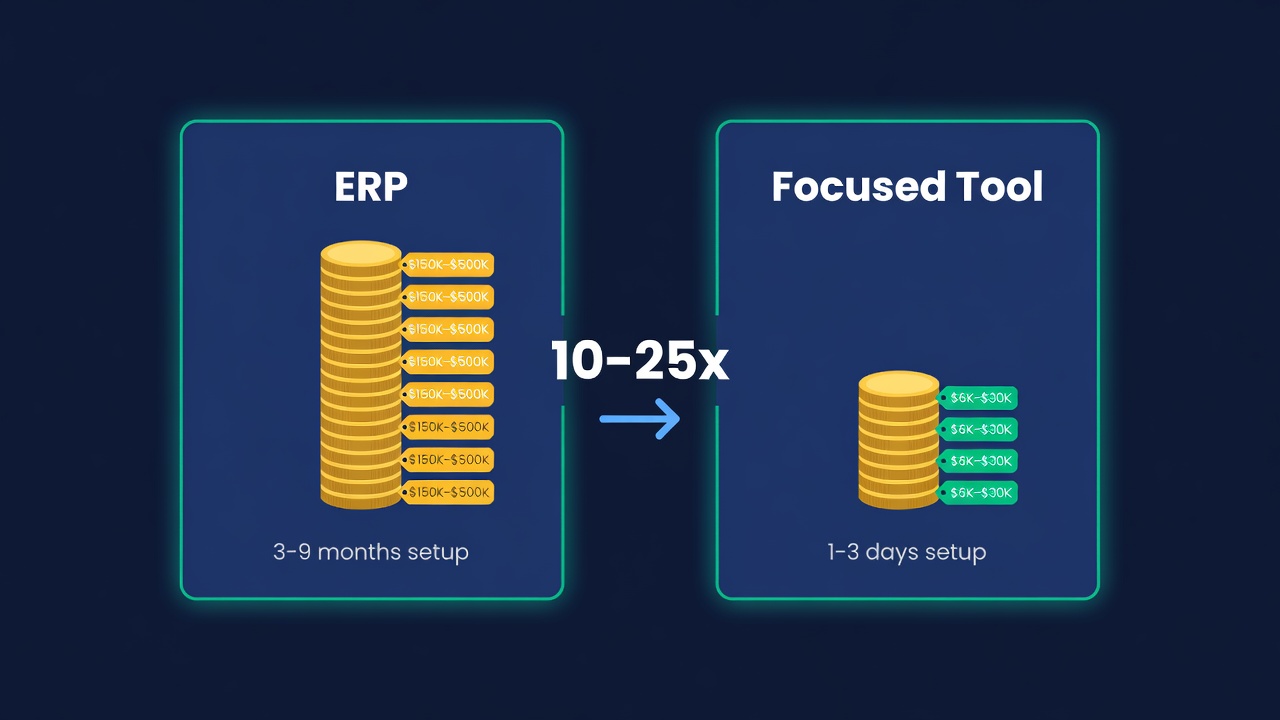
I am not saying ERPs are overpriced for what they do. If you need the full package - manufacturing, multi-entity accounting, HR - the cost is justified. But if you are paying $150K for an accounting system with a mediocre inventory module, you are spending enterprise money on a reseller problem.
When You Actually Need an ERP
Be honest about which of these apply to you:
- You manufacture products. You need bill-of-materials, production scheduling, raw material tracking. This is the single strongest reason to buy an ERP. Focused inventory tools do not do production planning.
- You have 100+ employees. You need HR, payroll, and operational controls that span departments. An ERP ties those together.
- Multi-entity accounting. You run multiple legal entities and need consolidated financial statements. Your CFO or accountant is asking for this specifically.
- Revenue above $20M with complex operations. At this scale, the cost of an ERP is a rounding error on revenue and the integration value starts to compound.
If two or more of those apply, talk to an ERP vendor. Seriously. It will be painful and expensive, but you need it.
When You Do Not Need an ERP
This is most e-commerce sellers I talk to:
- You buy finished products from suppliers and resell them. No manufacturing, no BOM, no production runs.
- Your team is under 20 people. Maybe under 10.
- You sell on Shopify and Amazon. Maybe a third channel.
- Your annual revenue is under $10M. Maybe well under.
- Your main pain is inventory - knowing what to order, when, and how much. Not consolidating financial statements.
If that sounds like you, an ERP will cost you six figures to solve a problem that a $200/month tool solves better. I have watched it happen. The ERP vendors will not tell you this because a $150K implementation is a lot more commission than a $200/month subscription.
The ERP Trap for Resellers
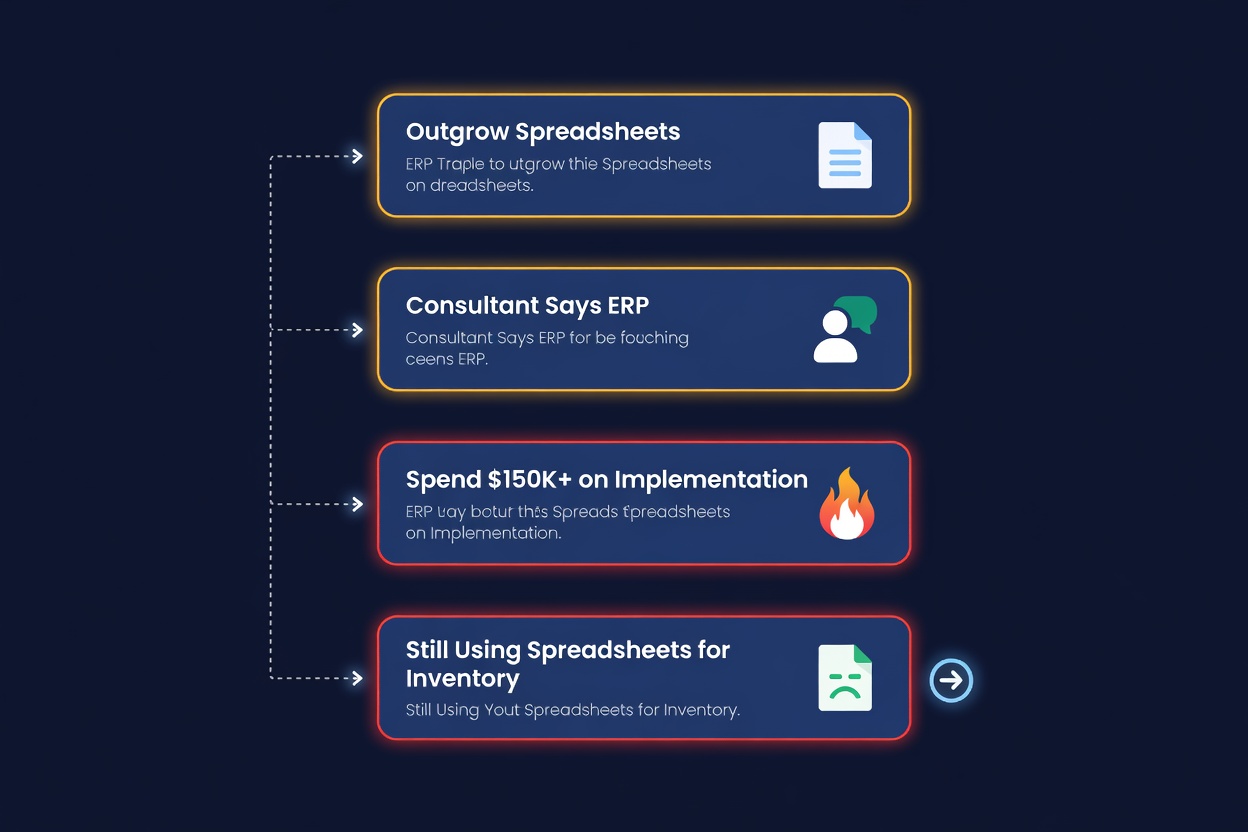
Here is the pattern I see over and over. A seller outgrows spreadsheets and starts looking for "real software." They Google around, talk to a few vendors, maybe hire a consultant. The consultant recommends an ERP because that is what consultants recommend - it is a bigger project, a longer engagement, more billable hours.
The seller spends 6 months implementing. They get great accounting. They get decent warehouse management. But the Shopify integration is clunky, the Amazon connection requires a third-party middleware, and the demand forecasting module was designed for manufacturers with stable B2B order patterns, not for e-commerce sellers with flash sales and seasonal spikes.
So they end up running an ERP and a spreadsheet. Or an ERP and a separate Amazon tool. The system that was supposed to be the single source of truth becomes one of three systems they check every morning.
The sunken cost makes it worse. After spending $100K+ on implementation, nobody wants to admit it was the wrong call. So the ERP stays, the workarounds multiply, and the actual inventory decisions still happen in a Google Sheet at 11pm on Sunday night. I have seen this exact scenario play out at least a dozen times.
What the ERP Vendors Will Not Tell You
ERP sales cycles are long and lucrative. A NetSuite implementation partner makes $50,000-$150,000 per deal. A SaaS inventory tool makes $200/month. The incentives are obvious.
Here are the questions that will get an honest answer from an ERP salesperson approximately never:
- "My business is purely resale with no manufacturing. Do I still need an ERP?" (Answer: no.)
- "Can I get equivalent inventory functionality from a $300/month tool?" (Answer: for resellers, yes.)
- "What percentage of your customers under $10M revenue are actually using the inventory module daily?" (Answer: fewer than they will admit.)
I am not anti-ERP. I am anti-buying the wrong tool. If you need an ERP, buy one. If you need inventory software, buy that instead and save $140,000.
The Decision Comes Down to Manufacturing
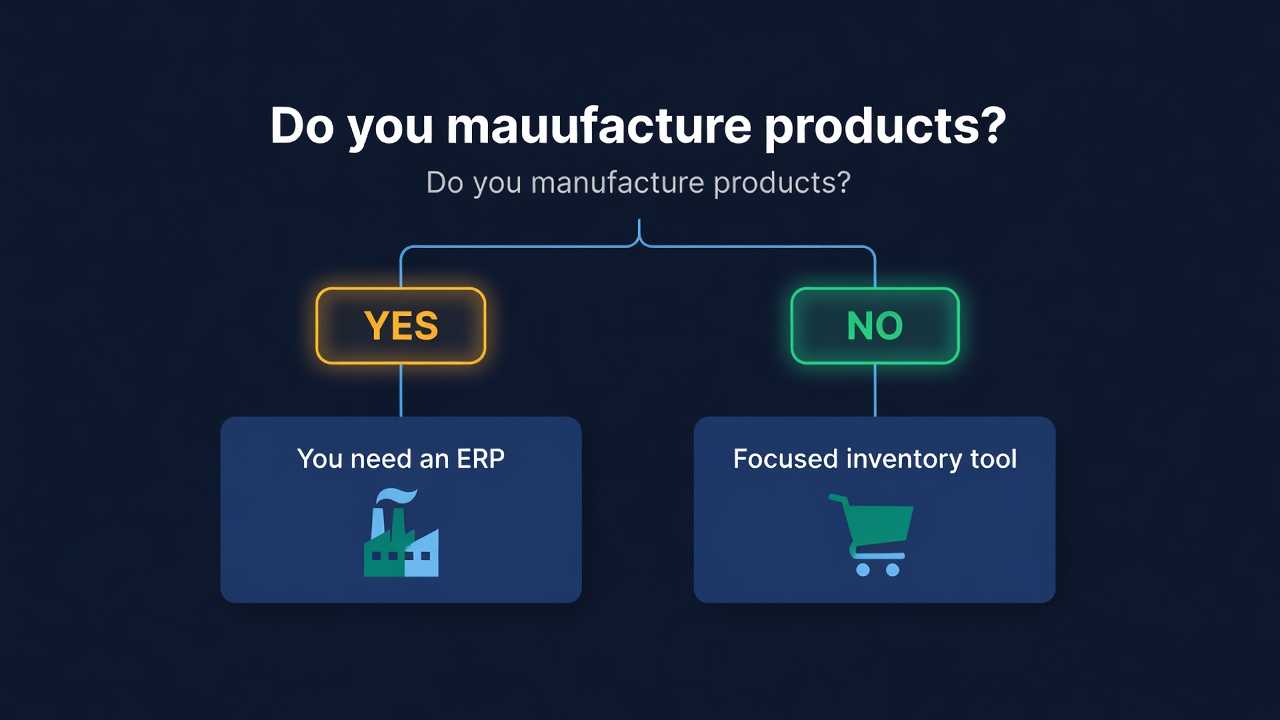
Strip away the sales pitches and it comes down to one question: do you make things or buy things?
If you manufacture - if raw materials go in and finished products come out - you need production planning, and no focused inventory tool gives you that. Get an ERP. Accept the cost. Budget for the implementation timeline.
If you resell - if you buy finished goods from suppliers and sell them through Shopify, Amazon, or other channels - you need multi-channel inventory visibility and demand-driven purchasing. That is what focused tools are built for.
Katana, for example, positions itself as an inventory tool but is really built for manufacturers. They have production planning, bill-of-materials, and shop floor management. Great for a D2C brand that makes its own products. Wrong fit for a reseller with 500 SKUs from 15 suppliers.
Who We Built ReplenishRadar For
We built ReplenishRadar for the second group. Resellers. People who buy products and sell them on Shopify and Amazon.
We do not have a manufacturing module. We do not have HR or general ledger integration. We did not build those things because adding them would mean doing them badly, and sellers who need those features should buy a system designed around them.
What we do instead: connect to your Shopify stores and Amazon accounts, pull every SKU into a single view, run demand forecasts on your actual sales history, and generate purchase order recommendations based on your lead times, safety stock, and supplier constraints. The thing you actually open a spreadsheet to figure out - "what do I need to order this week?" - is the thing we automate.
Setup takes an afternoon, not six months. And you will never need to hire someone to administer it.
Try ReplenishRadar free for 14 days ->
The Hybrid Approach
Some sellers end up with both, and that is fine - if it is intentional. You might use QuickBooks or Xero for accounting, ReplenishRadar or a similar tool for inventory, and Shopify/Amazon as your sales channels. Each system does what it is best at.
This is not a compromise. It is how most successful e-commerce businesses under $10M actually operate. The "single system for everything" pitch sounds clean but often means "mediocre at everything."
If you grow into manufacturing or multi-entity accounting later, you will migrate to an ERP with better data and clearer requirements than if you had jumped in prematurely.
Related Reading:
- The Complete E-commerce Inventory Management Guide
- From Spreadsheets to Software: When to Upgrade
- Best Shopify Inventory Management Software
- Best Multi-Channel Inventory Software
- Cin7 Alternative for Shopify + Amazon
- Brightpearl Alternative for Shopify + Amazon
- Finale Inventory Alternative for Shopify + Amazon
Frequently Asked Questions
Get notified when it matters
Amazon and Shopify change the rules constantly. We'll email you when something affects your business.
See what your inventory is really doing
Doing $5M+ in revenue? Talk to our team
Related Posts
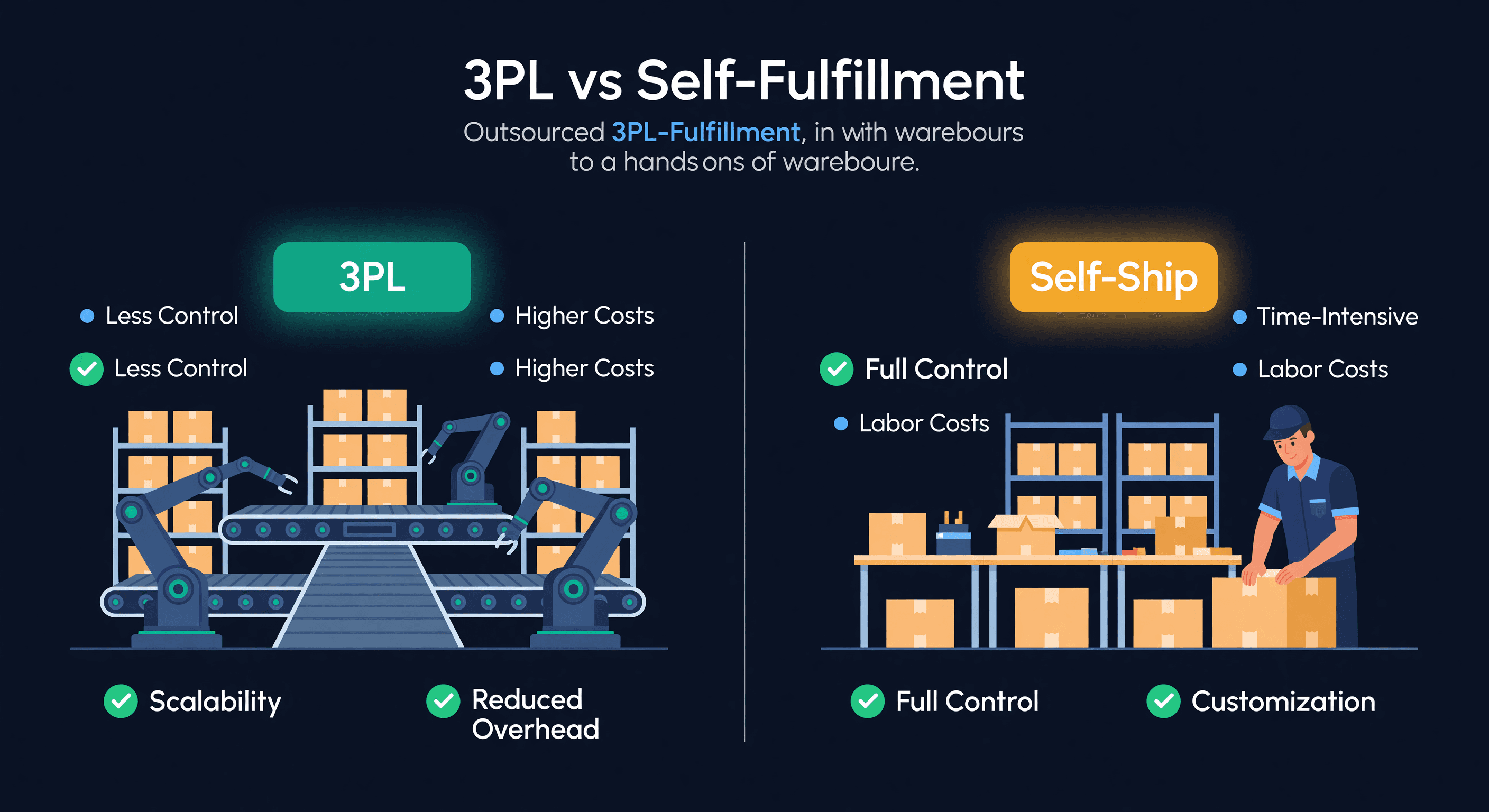
3PL vs Self-Fulfillment for E-commerce
A real cost comparison of 3PL vs self-fulfillment, with the math on when to outsource, when to keep it in-house, and why hybrid models win.
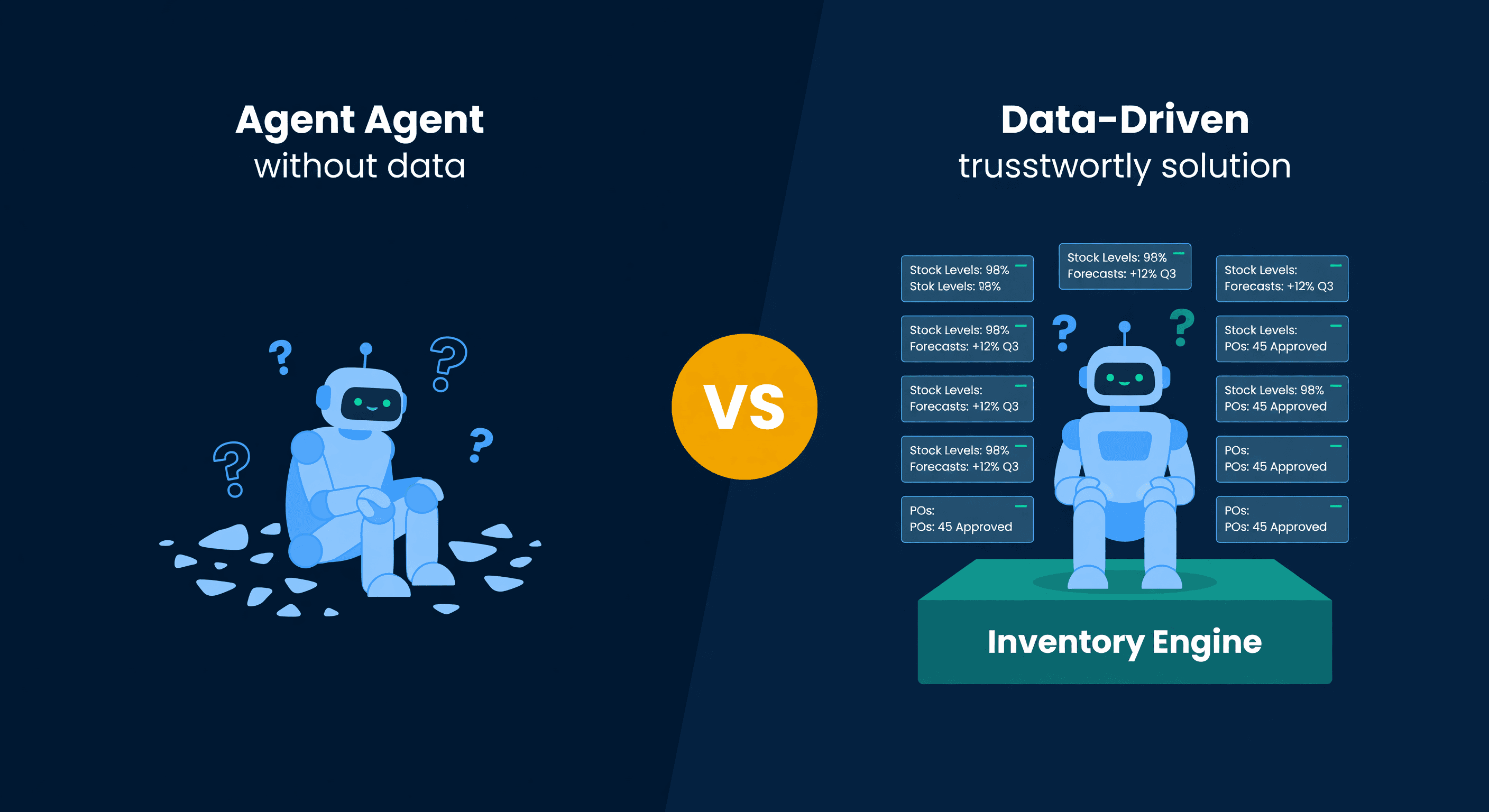
OpenClaw vs Inventory Software: Where AI Agents Fall Short
OpenClaw handles basic Shopify stock alerts but stops short on FBA lead times, multi-channel forecasting, and reorder math. The honest breakdown.
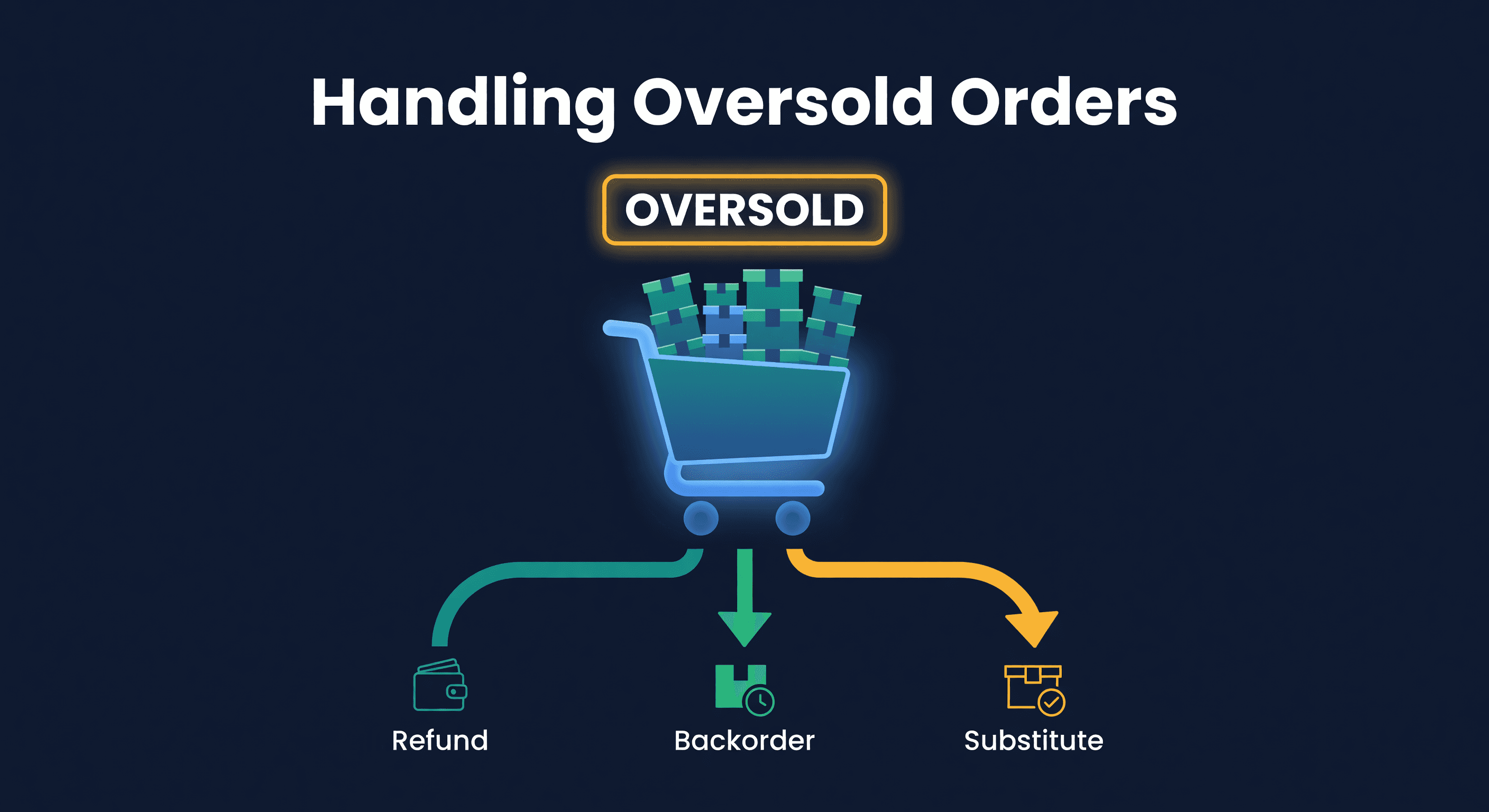
How to Handle Oversold Orders in E-commerce
Why overselling happens on multi-channel stores, what it costs you, and the prevention strategies that actually work, from buffer stock to real-time push sync.
