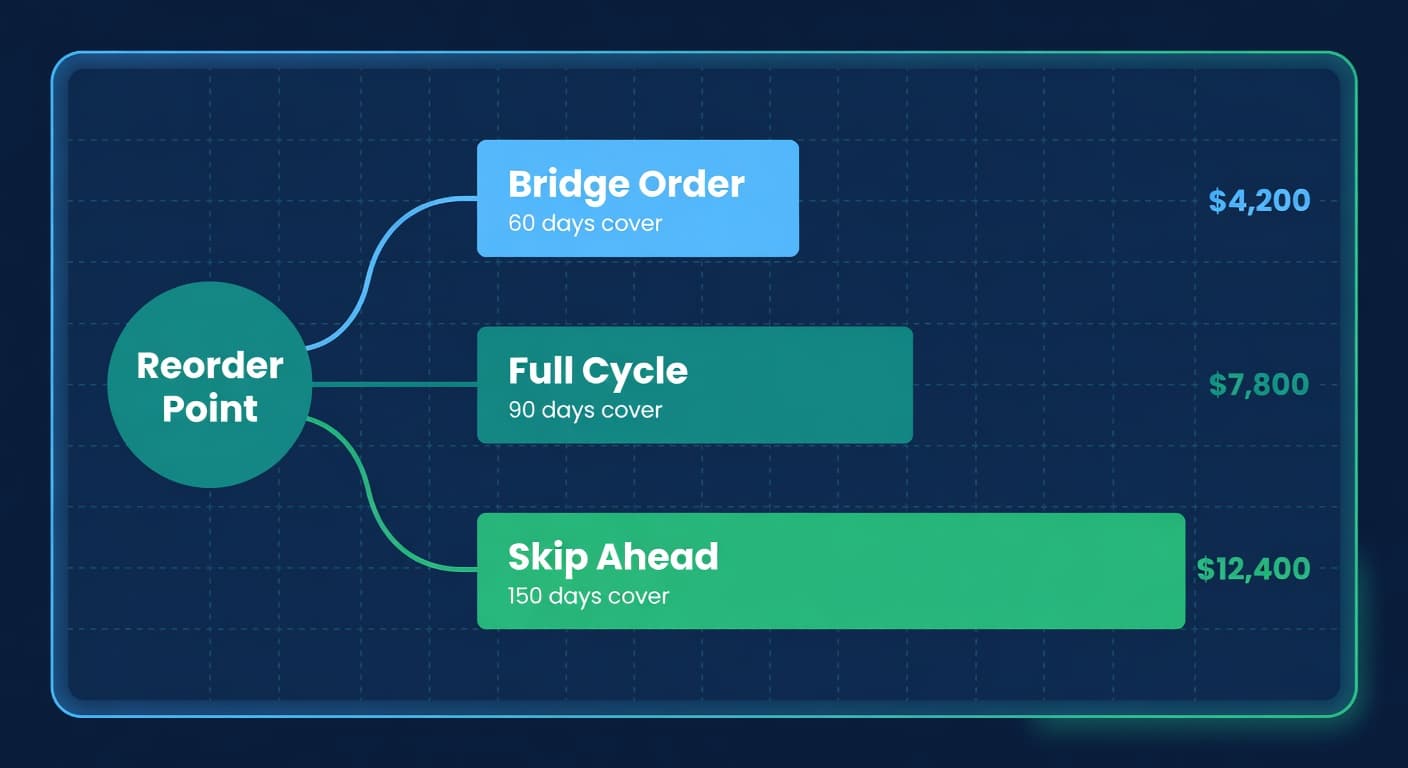
Three Ways to Place the Same Order
One SKU, Three Quantities, Three Outcomes
Your inventory tool tells you to order 500 units. But is that the right number for this month? Maybe you are cash-constrained after a big Q3 buy. Maybe Q4 is around the corner and you know demand will double. Maybe your supplier just offered 8% off if you hit a volume threshold by Friday.
The "right" quantity depends on your situation right now. Not your situation in general. Not your average situation over the last year. Right now.
A single suggested number does not give you that choice. A formula produces it, and you either accept it or override it with a guess. One number. No context. No alternatives.
We think that is a problem worth solving.
The Three Strategies
There are three distinct ways to think about how much to order. Each one answers a different question. We will run all three against the same SKU so the tradeoffs are concrete.
The setup: You sell a kitchen gadget. It moves 20 units per day. Your supplier needs 21 days to deliver. You order from this supplier every 30 days. Your safety stock is 120 units. The landed cost is $12 per unit.
Now the question: how many do you order?
Bridge: Cover the Gap
A bridge order answers one question: what is the minimum I need to not stock out before my next chance to order?
You are not trying to build inventory. You are buying time. The bridge covers demand between when the new shipment arrives and when your next ordering window opens, plus enough safety stock to sleep at night.
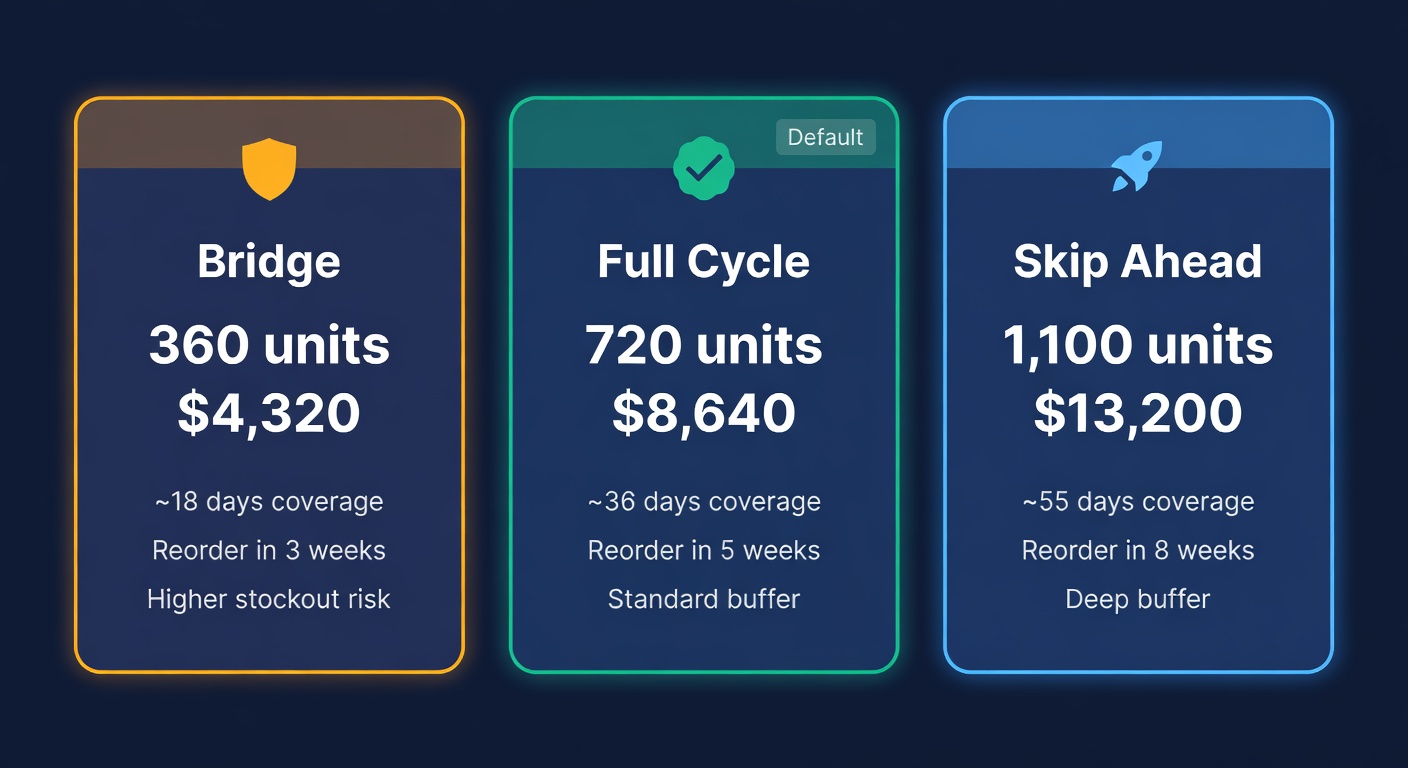
For our kitchen gadget, a bridge order might be 360 units. That is 18 days of sales coverage after the shipment lands, just enough to reach the next ordering window with safety stock intact.
Cost: $4,320.
When bridge orders make sense:
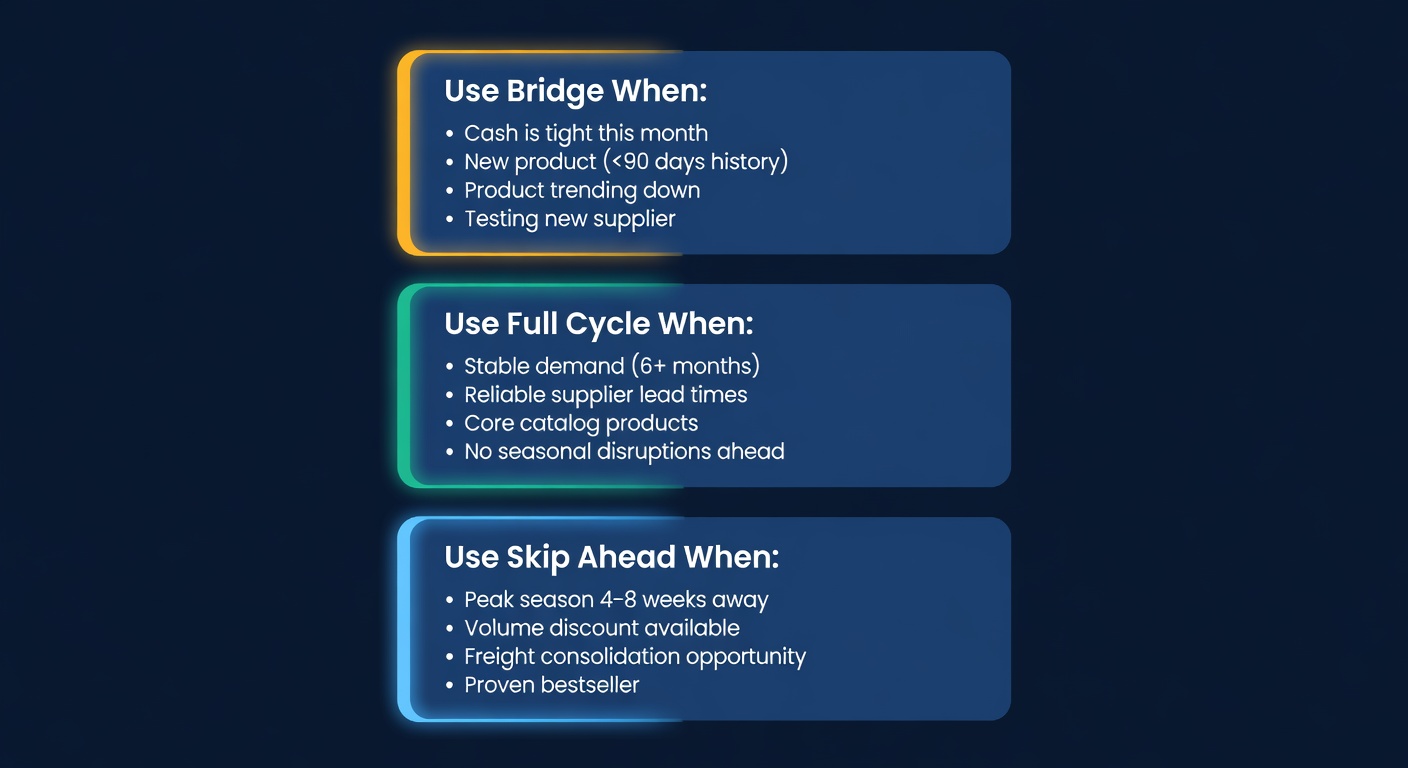
- Cash is tight this month and you need to spread your purchasing budget across more SKUs
- You just launched this product and you are not confident in the demand forecast yet (90 days of sales history is a sensible minimum before trusting a forecast, and even that is shaky)
- The product is trending down and you do not want to overcommit
- You are testing a new supplier and want a small first order before going bigger
Bridge orders are the conservative play. They keep you in stock without tying up capital. The tradeoff is that you will be ordering this SKU again sooner, which means more POs, more freight events, more coordination.
Full Cycle: The Standard Replenishment
A full cycle order is the textbook answer. It covers demand during the lead time, plus demand during one full review period, plus safety stock. This is what a standard reorder formula produces when it gives you "the number."
For our gadget: 720 units. That covers the 21-day lead time (420 units) plus the 30-day review period (600 units) minus what you have in transit, adjusted for safety stock. You will not need to think about this SKU again until your next scheduled ordering window.
Cost: $8,640.
This is the default for a reason. It balances holding cost against ordering cost. It keeps you stocked through a complete cycle without over-committing capital. For most of a stable catalog, most of the time, this is the right answer.
Full cycle is the sensible default for core products: steady sellers with 6+ months of history, reliable demand and no upcoming disruptions. Set it up, place the order, move on.
Skip Ahead: Order Aggressively
A skip-ahead order exceeds the standard cycle. You are intentionally buying more than you need for the next period because the math favors it.
For our gadget: 1,100 units. That covers about one and a half cycles, so you will not reorder this SKU for about eight weeks instead of five.
Cost: $13,200.
That is a big number. Why would you do this?
Seasonal ramp. Q4 is six weeks away and you know from last year that this gadget sells 35 units per day in November and December instead of 20. If you wait for the full cycle order to run out and reorder at your normal cadence, you will hit peak demand during a lead time gap. Skip ahead now, and you arrive at November already stocked. Place a "normal" order in September instead, and a bestseller can run out in early November, with the next delivery still weeks away.
Volume discount. Your supplier says you get 8% off at 1,000 units, but the pricing expires Friday. That is $1,056 in savings on this one SKU. Your extra holding cost for carrying 380 additional units for 19 extra days is at most about $60 (assuming 25% annual carrying cost on their full value). The discount pays for itself at least 17 times over. If you want to pressure-test whether the volume break actually wins, plug the numbers into our EOQ calculator. It accounts for holding cost against the savings from larger batches.
Freight consolidation. You have three SKUs from the same supplier, all close to reorder. Skip ahead on all three, combine into one PO, and ship one container instead of three LCL shipments. The freight savings alone can justify the extra holding cost.
The Numbers Side by Side
Here is what the three strategies look like for our kitchen gadget:
| Bridge | Full Cycle | Skip Ahead | |
|---|---|---|---|
| Quantity | 360 units | 720 units | 1,100 units |
| Order cost | $4,320 | $8,640 | $13,200 |
| Days of coverage | ~18 days post-arrival | ~36 days post-arrival | ~55 days post-arrival |
| Next reorder | ~3 weeks | ~5 weeks | ~8 weeks |
| Holding cost (25% annual, on average stock) | $45/month | $90/month | $138/month |
| Stockout risk | Higher (thin buffer) | Low (standard buffer) | Very low (deep buffer) |
| Cash freed up | $4,320-$8,880 vs alternatives | Baseline | -$4,560 vs baseline |
Same SKU. Same supplier. Same lead time. Three different answers, and each one is correct depending on what you are trying to accomplish this month.
A Small, Messy Example
The kitchen gadget is a tidy hypothetical. Recommendations on a live screen are often smaller and messier, so here is one.
The item was out of stock. Its supplier lead time was 60 days, its order cycle was 30 days, and its safety setting was 7 days. It had very little sales history, and the screen said so with a limited-history notice. It also warned that standard ordering would miss demand, which is what happens when the shelf is already empty and the next delivery is two months out. Two options appeared:
| Option | Units | Item cost | Coverage displayed |
|---|---|---|---|
| Full Cycle | 4 | $67.04 | 180 days |
| Skip Ahead | 5 | About $84 | 240 days |
Recommendation captured on October 2, 2026. The quantities are shown to illustrate how to read the options, not as a customer result. Costs are item cost only.
Start with the unit cost. $67.04 divided by 4 is $16.76 per unit. That is item cost: what the units cost from the supplier, before freight, duty or prep. It is not landed cost, so the fifth unit costs you $16.76 plus its share of those charges.
So the real question is whether 60 more days of coverage is worth one more unit of cash. On an item with a 60-day lead time and almost no sales history, we would take the Full Cycle. The extra unit pays for demand nobody can see yet, and the next ordering window is only a cycle away. Give the same item a year of steady sales and the answer could flip.
Mixing Strategies Across Your Catalog
No single strategy fits every product.
A workable rule: bridge orders for new products, full cycle for the core catalog, skip ahead heading into peak season.
New products get bridge orders until there are 90 days of sales data. It makes little sense to commit $8,000 to a product that might sell 5 units per day instead of 20. The demand forecast for a product with 3 weeks of history is a guess dressed up as math. Buy small, learn fast, ramp up when the data supports it.
Core catalog gets full cycle orders. These are the products with a year or more of sales. The forecast is reliable. The supplier lead time is predictable. No drama. Just order the standard quantity on the regular cadence.
Peak season (Q4, Prime Day, whatever your business's spike is) is when skip-ahead earns its keep. Start placing larger orders 6-8 weeks before the ramp begins. Yes, working capital takes a hit in September and October. But cash tied up in inventory that sells beats scrambling for air freight in November.
The Real Problem with One Number
Here is the trouble with a single reorder number: it gives you a quantity but not the reasoning. Was that 500 units a bridge quantity because you are close to your next ordering window? A full cycle? Something in between? You cannot tell, and that makes it impossible to adjust intelligently.
When you can see all three options with the costs attached, you can make a judgment call instead of a gut call. You might look at the bridge quantity and think "I can afford more than that, let me go full cycle." Or you might see the skip-ahead cost and realize the freight savings from consolidating three SKUs justifies the extra capital.
That is the difference between a tool that does math and a tool that supports decisions.
How ReplenishRadar Handles This
This is one of the things we were most deliberate about when building ReplenishRadar. Each reorder suggestion shows up to three options (Bridge, Full Cycle and Skip Ahead) with the quantity, item-cost estimate and coverage for each. An option that needs no units is hidden. Bridge is also hidden when it comes out the same as Full Cycle, which is what happens when you order at the start of a cycle.
The options are sized from your supplier's lead time, your order cycle with that supplier, your current stock position and your safety stock setting. The demand rate, order cycle and lead time behind them are listed under the options, so when a number looks wrong you can see which input to question.
Stop at the Approval Boundary
Picking an option does not place an order. You open the recommendation from the Buy list, compare its inputs and options, and add your choice to buy review. Approving the purchase order and sending it to the supplier happen separately, in the Action Center.
That gap matters. An order is a commitment, and the moment before you approve it is the time to review the demand and supply assumptions behind your next purchase, and check which inputs need attention. In a weekly review, pick the items that are out of stock or close to it, open each one, and write down why you would approve its quantity. If the only reason is "the software said 4," keep reviewing.
See how three-option ordering works ->
When to Switch Strategies Mid-Cycle
One more thing. Your strategy for a SKU is not permanent. The same product can need a different strategy several times a year.
Take a seasonal bestseller. January through September, it gets full cycle orders. Boring. Predictable. Correct.
In early October, switch to skip ahead, so you are deep in stock before Black Friday.
In January, when post-holiday demand falls, switch to bridge orders for a month or two until the velocity stabilizes at its new baseline. Ordering a full cycle quantity based on December's demand in January is how you end up with six months of dead inventory by March.
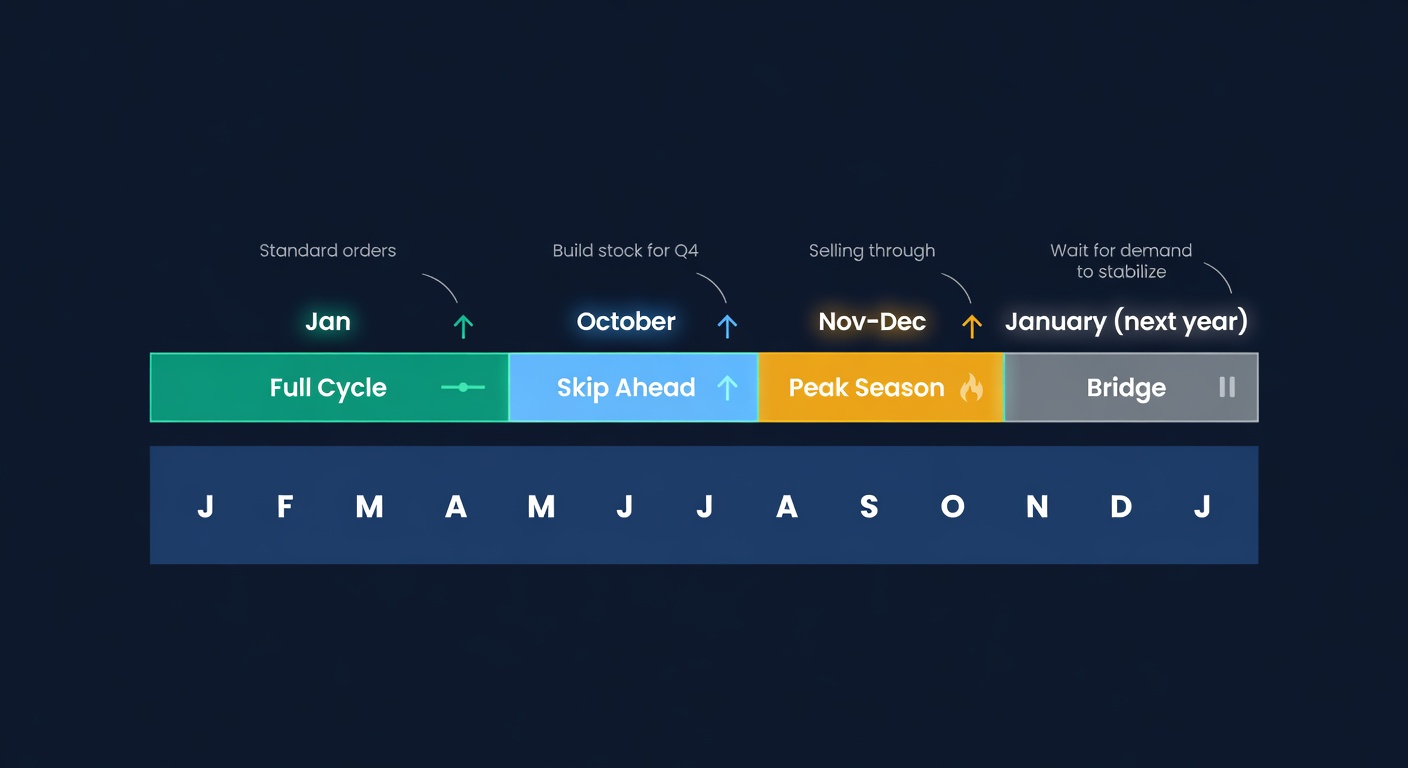
The strategy should match the moment. The moment changes.
Related Reading:
Frequently Asked Questions
Get notified when it matters
Amazon and Shopify change the rules constantly. We'll email you when something affects your business.
See what your inventory is really doing
Doing $5M+ in revenue? Talk to our team
Related Posts
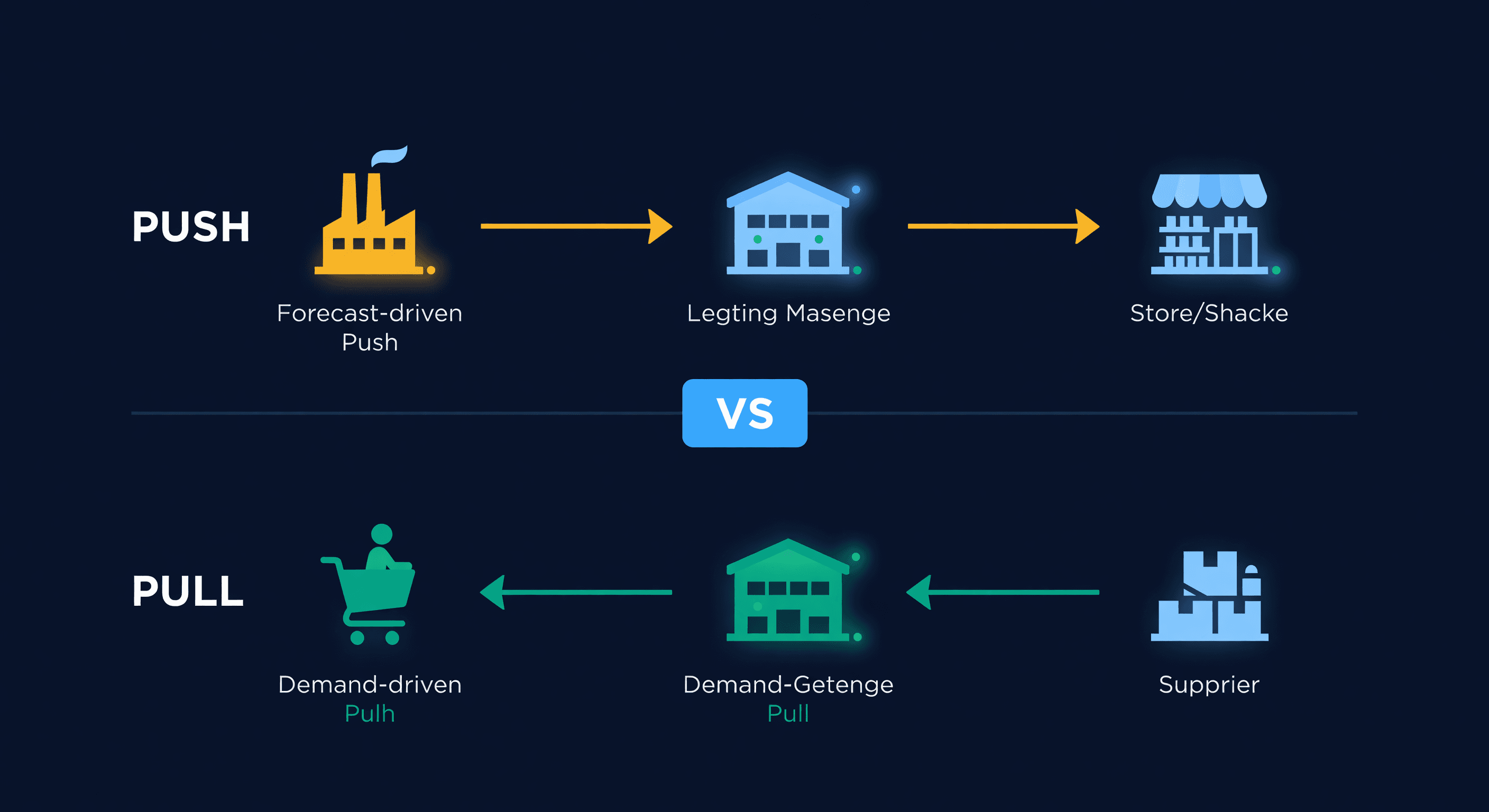
Pull vs Push Inventory: Which Model Wins?
Push inventory relies on forecasts. Pull inventory responds to demand. Most e-commerce sellers need both. Here's how to decide.
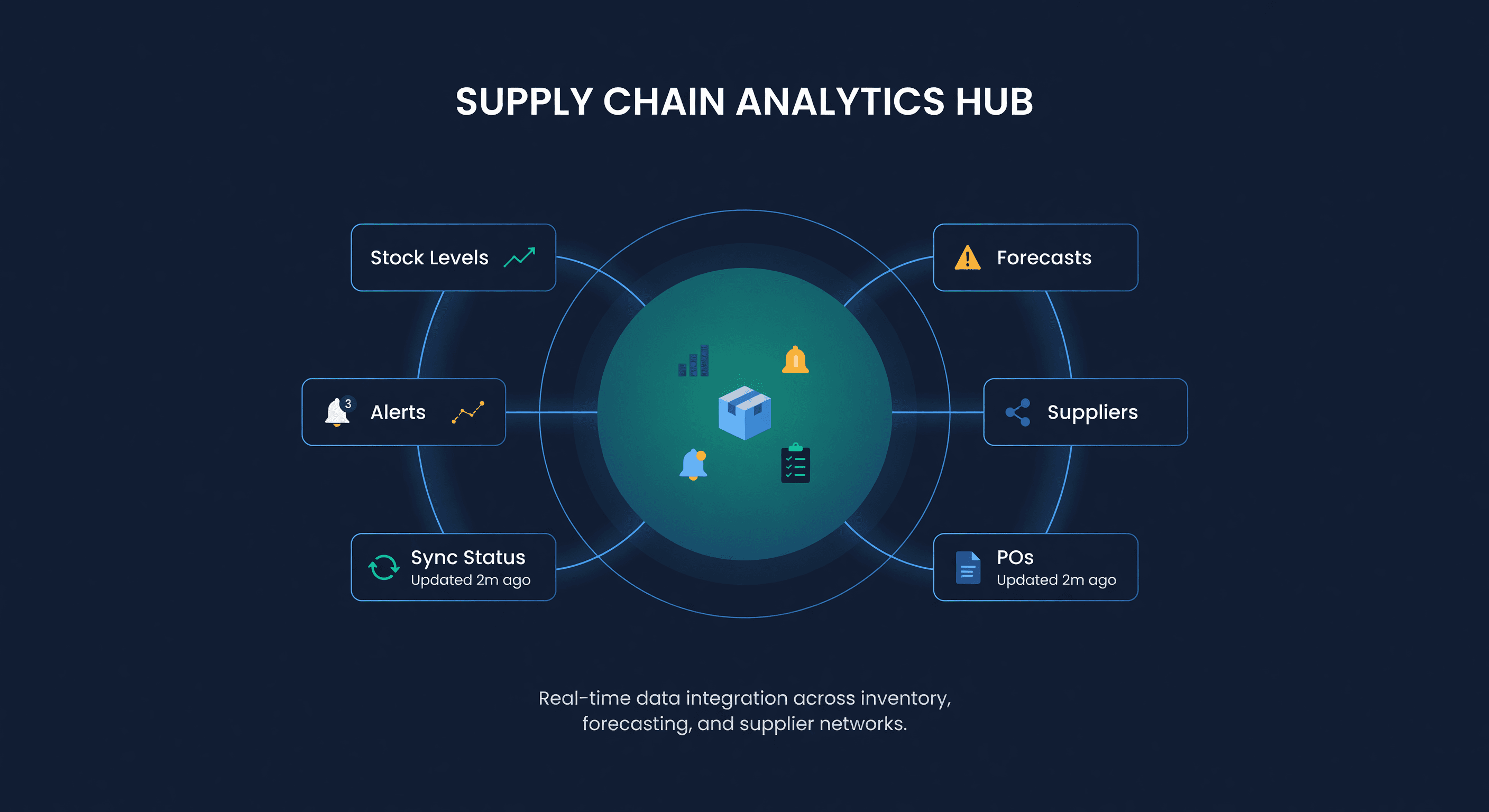
What Can an AI Agent Do With Your Inventory Data?
Use cases for AI agents in inventory management: morning briefings, stockout checks, PO drafts, and what agents still can't do.
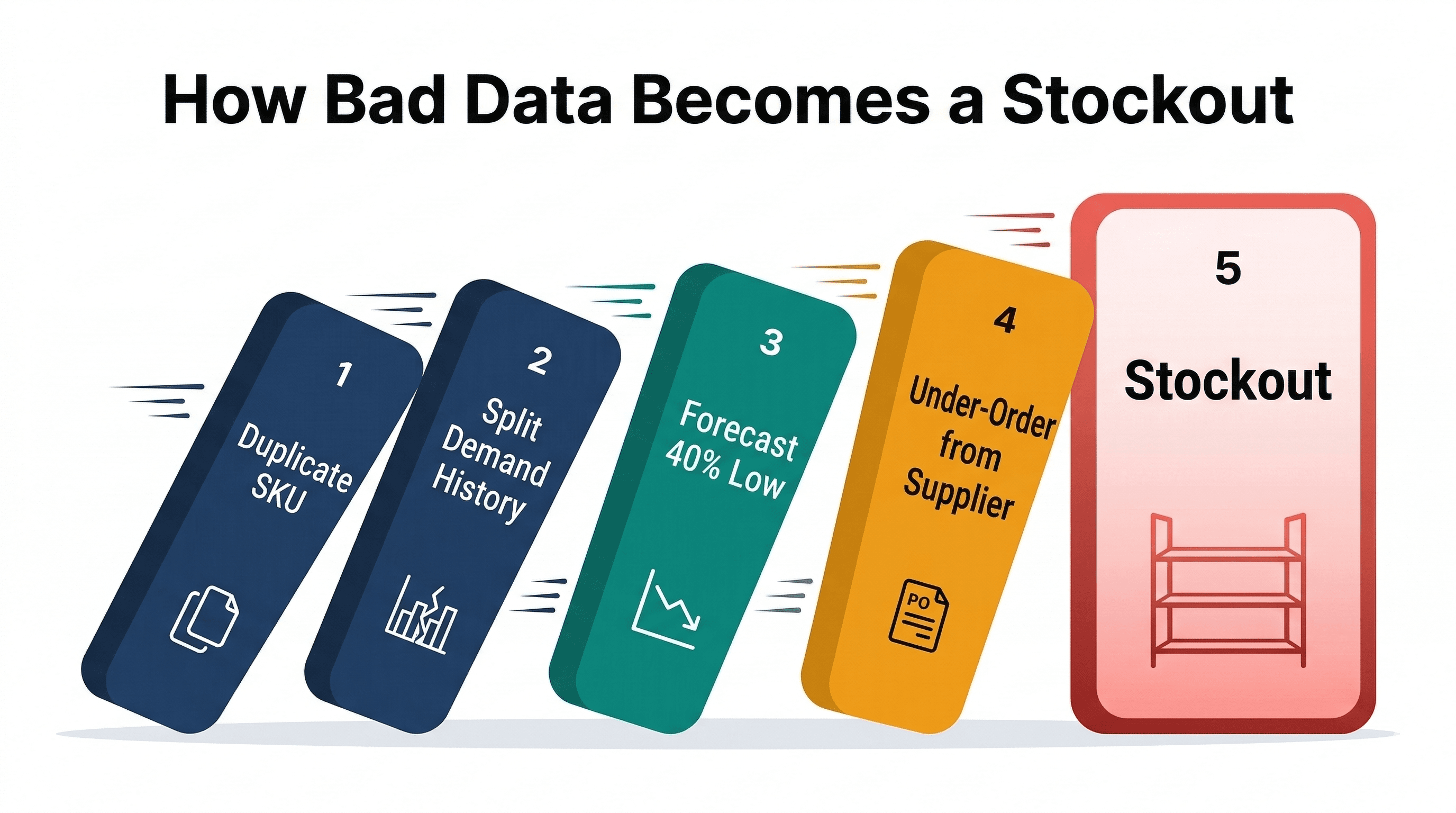
Your Inventory Data Is Wrong
How bad SKU data (duplicates, missing costs, unmatched listings, missing demand) breaks inventory forecasting and costs real money.
